


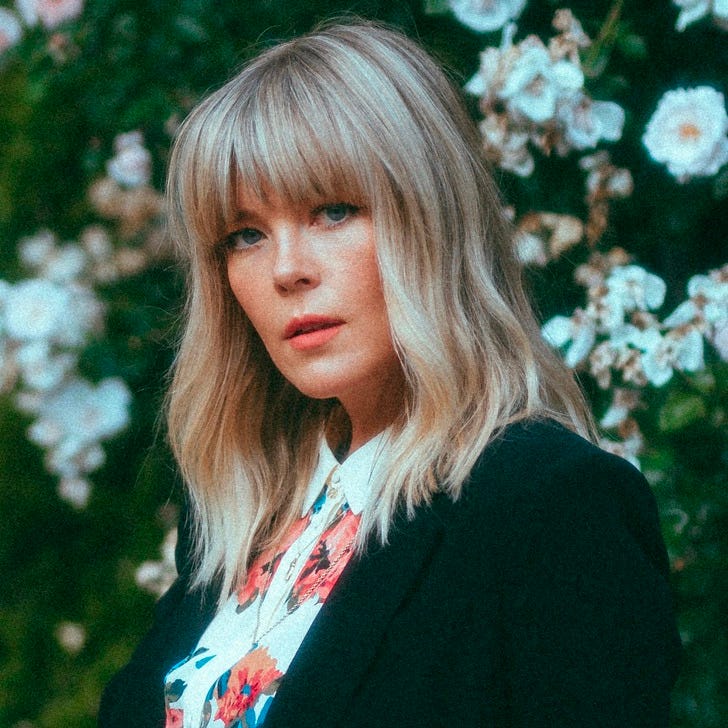
Chelsea Bieker’s writing has been referred to as “fascinating and entertaining” (The Brooklyn Rail), “endlessly readable” (Entertainment Weekly), and “larger than life and darker than hell” (Kirkus). Her debut novel, Godshot, was named an NPR Best Book of 2020, while her short story collection, Heartbroke, won the 2023 California Gold Medal Book Award for Fiction. Her latest novel, Madwoman, is already garnering significant praise, with The Washington Post referring to it as “a thoroughly modern addition to feminist fiction about mental illness and motherhood.”
A riveting page-turner, Madwoman tells the story of Clove, a wellness-obsessed, hashtag-wielding parenting influencer and mother of two who happens to have a shopping addiction, a mountain of debt, and dark secrets that even her husband knows nothing about. When Clove receives an unexpected letter from her imprisoned mother, she realizes she must reckon with the traumatic past she has tried so hard to forget before it destroys all that she loves.
Though Bieker’s books, which feature a rogue’s gallery of characters—alcoholics, abusers, thieves, and other ne’er-do-wells—are fiction, aspects of the stories pull loosely from her own childhood, a difficult one she’s written about in essays for Literary Hub, Marie Claire UK, and other publications. When I asked if she would consider writing a memoir, she replied, “Never say never.” But generally, she believes the act of writing fiction is a healthier way to deal with personal traumas.
“Fiction feels like the way I can explore things in a much deeper way,” she says. “I can amp up situations to be more blown out, more dynamic, and get a sense of what characters do in those moments that in real life are hard to come by. We can’t always have the conversations we want to have. We can’t always have the confrontations we want to have. It might not be safe to do so. But on the page, I find such freedom to put my characters in those moments and explore the what ifs. I have so many ‘what if’ questions in my mind, and those questions have informed so many of my ideas for stories and novels. What if that had gone differently? What if that person stayed instead of left, or said yes instead of no? I definitely have thought of memoir and considered it. I have never really felt ready for that, and I don’t know if I ever will. I think it comes with its own set of complications that with fiction I get to skirt around a little bit.”
Over a recent Zoom call, Bieker chatted with me about her influences, the joys of writing on Substack, and how the loss of her mother continues to influence her work.
This content contains affiliate links. I am an affiliate of Bookshop.org and I will earn a commission if you click through and make a purchase.
SANDRA EBEJER: Congratulations on Madwoman! Where did the idea for this book come from?
CHELSEA BIEKER: When my daughter was about two, I stopped breastfeeding her, and I had a hormonal crash. I was doing a lot of investigating about what was happening to me, because there’s so little known about post-weaning mood disorders—something I now know a ton about, but at the time, had never even heard of. So it was born in that time period where I was also grappling with the ways my identity felt different as a mother. That was eight years ago. I started writing a short story called “Madwoman” around that time, and it felt very urgent. Something about the voice felt really interesting to me, and it was different than my other work. It was more close to my lived experience. I put a pin in it because I was still finishing my other two books that came out first, and then when lockdown happened in 2020, I picked it back up and realized it was not a story, it was a novel. So it’s had a longer journey, but once I sat down to write it, it came out pretty fast.
You said on Instagram that you began this book thinking that you were going to write about motherhood and wellness culture, but you soon realized you were writing a book about your and your mother’s experience with domestic violence. Given that you’ve experienced these issues personally, how was it for you, emotionally, to write this book?
I had some idea about wanting this book to be a funny book. [Laughs] When my first two books came out, I was surprised at how they were discussed. People felt they were very dark, which they are, but it seemed to be the focus of them when I didn’t really see them that way. And so I was like, “Well, fine. I’ll write this funny book.” [Laughs] I remember texting my friend. I was like, “I tried to write a funny book, but now I’m writing about domestic violence.” As I was examining motherhood, I felt like I couldn’t adequately explore it without confronting my own mom’s experience of motherhood, because so much of the book is about generations. [Clove is] looking at her children, but she’s also looking at her mother. She feels anger toward her mother and some of her perceived wrongs, and also a growing compassion toward her mother. She has to confront the conditions under which her mother mothered her, which were impossible conditions. She realizes, once she’s in the weeds with her own kids and under much better circumstances, “I can’t believe my mom had to caretake and also endure the abuse that was coming from her [husband].” The book really became its own thing at that point, and I was just holding on for dear life.

The book is dedicated to your mom. I read the essay you wrote for Lit Hub about your challenging relationship with her. How much would you say that she influences your work? And do you find yourself using fiction as a way to work through the trauma that you’ve experienced in your own life?
It informs everything, really. It touches everything. It’s definitely a driving force. That early loss in life of her was very formative for me, and it did shape the way I saw the world. I was always looking at the world through that lens of grief, really. I didn’t know that I was living in grief until I was an adult in therapy and a therapist mentioned it in passing. I was like, “She’s alive. So how am I in grief?” That was a huge part of the journey of learning about complex grief and ambiguous loss, and it does inform my work, because I don’t even know how I could avoid it. The new project I’m writing right now is still touching it. It’s touching it from a different angle, because it’s so prismatic, it’s so nuanced, and it changes as I get older. My way of thinking about it is different than it was 10 years ago, and that’s interesting to me, how it will shape shift over time. But yeah, it is very formative.
Creative Reverberations is a reader-supported publication. Each interview takes many hours of work. To read all posts and support ad-free, independent journalism, please become a paid subscriber.
The novel’s protagonist, Clove, is such an interesting character. How did you go about creating her? Was she fully formed when you began writing, or did she evolve over time?
She evolved. Her voice drives the novel, and I wanted her to be a character that was in this very confessional moment. I love when I find a book that’s using that direct address, like a character speaking to another character. In this novel, she’s speaking directly to her mother the whole time. She has a desire to be known for what she has experienced, and also the more mundane things of her life that there was never really any time for her mother to notice about her. Because when you’re living in that survival period, you’re not really seeing things clearly. You’re not really pausing and getting to know your daughter.
A huge theme of the book is the way that violence comes between women. She feels this sense of, “I want you to really see me.” It creates intimacy with her and the reader, I hope. And she’s trying to create some intimacy with her mother, too. I wanted the book to show the way that her past trauma informs the daily motions of her life. Even though her life looks very safe, looks very routine, the trauma that she has endured is still in the room with her. It’s tricky to write about PTSD or memory in a way that feels urgent and not gimmicky on the page, and that was a goal of the book. I was like, I have to figure out how to do it, because it’s so true to my own lived experience—the way that you can be in the safest moment ever and the ghosts are still in the nursery. I wanted to capture that.
I’ve interviewed many authors about their process and it’s always fascinating to hear how they begin a novel. Some start with a nugget of an idea, some start with a title, some have a character in mind but little else. What’s your process? What do you begin with and how do you map out where the story is going?
I love to have a title. It helps me have something solid to hang everything on. Madwoman was always the title for the book, which was nice. I never questioned it. It felt right to me and it was that play on the many meanings of that word. But it almost always seems to come from a voice. Once I can nail the sound of a voice—literally the sonics of a sentence, of how a character is going to be talking and thinking—that informs what they see, what they notice, how they talk to other characters, what they’re willing to do, how desperate they are. It tells me a lot.
When I lock into that voice, it’s like the high we’re all chasing as writers, the feeling of something flowing. Around the midway point of the process, I like to think more strategically about plot. I will do some outlining, but generally I’m not doing that in the beginning. Or even if I try in the beginning, I know that I’m holding it very loosely because it’s going to change in the writing process. I love when I have an idea of what a book is going to be and then it turns into something unexpected. That’s also a cue to me that I know something’s working well, when I feel like, “Whoa, I didn’t see that coming!” That element of surprise is important for me in the process.
Were there any books or authors that you turned to when you were working on this to help inspire the process?
Yeah, I call them my North Star books. There were several because when I realized this is really a book at its core about domestic violence and the effects of, I was very curious what novels exist out there that are primarily about that. Many novels include it in some way, but there’s not an immense amount that are truly about that.
The first story I ever encountered was, as a child, the movie Sleeping with the Enemy, which is a novel by Nancy Price from 1987. I never knew it was a novel. I encountered it as a movie, in second grade. I remember telling my teacher, “Sleeping with the Enemy is my favorite movie!” And her being like, “Are you... Are you sure?” I didn’t think that was weird. I loved it because it was a survival story. It not only reflected the experience that my mother and I had, it also showed a woman escaping and surviving and getting justice at the end, which I did not know was possible. That was huge.
Later in life, as I wrote this book, I found the novel by Nancy Price. I thought it was an excellent book. I loved it just as much as the movie, probably more. A more recent book was Animal by Lisa Taddeo. That book opened up a part of me. It gave a sense of permission about accessing the rage that I felt, and I wanted the character to feel. I think that’s a novel that just does not hold back on anything. It’s incredibly brave in its scope. Reading that helped me click into the story of Madwoman even deeper.
There were more. The book No Visible Bruises by Rachel Louise Snyder is a work of amazing journalism. It was very formative. I had my own lived experience and observations of domestic violence, obviously, and its longer-term effects on me, but I wanted to read what’s been written about it and see how my experience lined up with research and statistics. I went back in time and read a lot of the Lenore E. Walker books. She was a feminist pioneer in the ’70s and ’80s researching domestic violence because it had only recently been criminalized then. I think we think we’re further than we really are with it, and then you go back and you’re like, actually, this has only recently been something that was considered not a marital issue. I wanted to encounter what has been written about it in that way. There’s many beautiful books that were helpful to me in the process, but those were some of the main ones.
In addition to your books, you run a Substack, Make Up Your Life, which covers a wide range of topics. What has your experience been with using Substack for your writing?
I love Substack. I’m new to it. I have a ways to go with learning all of its tools, but I love that you can have a sustained connection there. I am so tired of videos on Instagram. I can’t even do TikTok. It hurts my eyes and brain. I don’t want to consume these little blips all day. I find it so draining. [Substack] reminds me of the days, pre-social media, where I was regularly a reader of different blogs. I loved that sense of continued readership and checking in, because it’s a longer connection. It’s deeper. I can explore an idea so much deeper there than I can in an Instagram post. So I feel excited by it, because this is a great way for authors to connect. This is a great way to talk about the writing process in the way that I see it. The right people that are interested in that will find it. Again, I have a lot to learn, but I really love it, and I’m so glad that it’s having a moment. I hope it’s a long moment.
You’ve taught classes on novel writing. What advice would you give to those who aspire to write a book?
One of the biggest things I find is that the writer has all the tools already. They already know the things that they think they don’t know. What’s missing is that element of self-trust. In some ways, work needs to be done around self-worth, too, because often the blocks they’re experiencing or the reasons they’re not writing or they can’t seem to finish is more rooted in what’s behind their daily decisions and what’s behind the emotions of their daily life—what they’re saying yes to, what they’re saying no to, it all is connected.
I used to teach craft-focused classes, and I’ve pulled back on that and try to address more of that deeper inner work. To me, that’s all that really matters. I mean, craft is helpful, and we can learn a lot, but we do most of that learning by reading. When you’re reading, you’ve dropped into that subconscious space. Your brain is learning when it’s doing that. Also, when you drop into that subconscious state for that deeper self-work, that’s where you can really make some changes, too, through visualizations, meditation, walking. I have students get clear with themselves—what are the stories they’re telling themselves about themselves?—before we can really do any real work. Because once they unblock some of that, it’s a beautiful thing that starts to happen. They can enter that flow state, they can get really clear on what their project requires, versus just staying in that upper surface area where you’re like, “What’s the next tip or trick I can use? Should I try setting a timer? Should I try emailing you every day after I write?” Listen, if that stuff worked, you’d already be doing that. Often, it’s a deeper issue.
Now that Madwoman is being shared with the world, what’s next for you? Are you working on your next novel?
I’m not writing much right now. I’m staying super present. I’m going on a book tour. I didn’t get to do that with my first two books, because they came out during the pandemic, so I’m very excited to experience that sort of whirlwind of meeting readers and booksellers and all the people that are making all of this possible. And yes, I am working on a new novel. I like to always have something in the cooker. It feels very grounding to be like, whatever’s happening in this more outcome-driven space, whatever will happen with the book, whatever reviews it’ll get, it’s okay, because I’m working on this thing that really feeds my soul. So yes, I’m working on another novel. I’m in a very exploratory phase with it, where I think I know what it’s about, but I know that it’s going to reveal itself to be something different.
To learn more about Chelsea Bieker, visit her website.
To purchase Madwoman, click here.
This interview has been edited for clarity and length.
You might also enjoy…

