


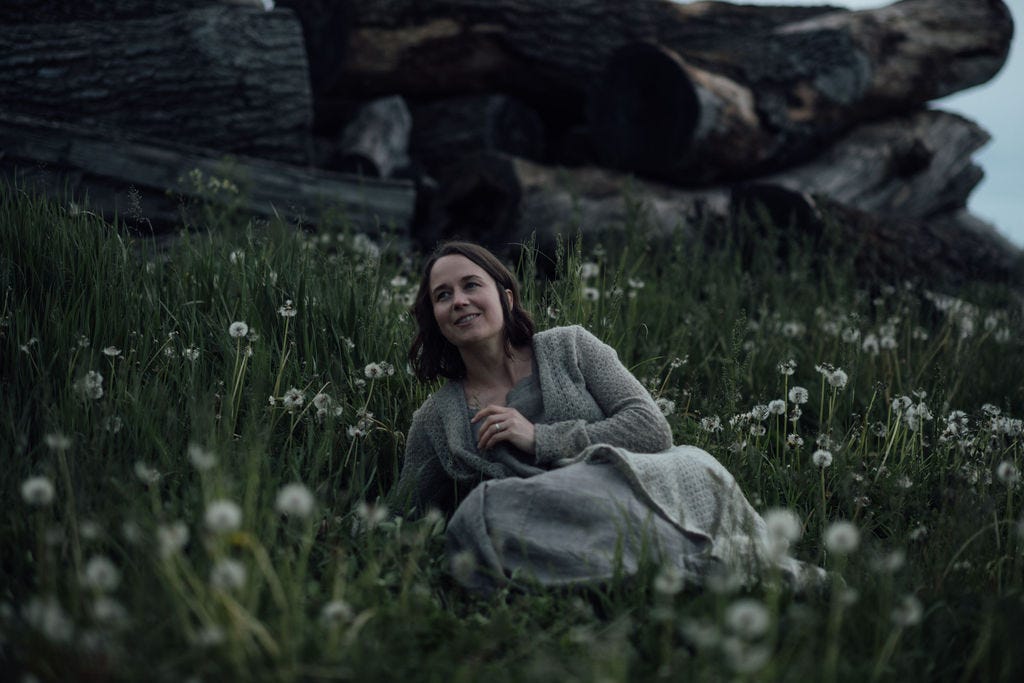
A few years ago, singer-songwriter Courtney Hartman was gutting and rebuilding her home when she and her husband were hit with a slate of unforeseen challenges: he fell off a ladder and was unable to walk for months, she was dropped by her booking agent, their car was totaled, and in the midst of it all, Hartman learned she was pregnant.
“Things kind of unraveled a bit,” Hartman says now. “It felt like we were stripped down. It was really humbling. Maybe humiliating is a better word for it. And in that space, I felt like I needed to put aside all the songs I had been working on in order to pay attention to what was happening in my body.”
She says she was hesitant to write about her pregnancy, knowing that her songs are typically shared publicly. Luckily for listeners, she pushed through the hesitancy and this fall released With You, a gorgeous collection of songs centered around pregnancy, labor, and motherhood.
“Coming to terms with that hesitancy and writing through that was really an important piece of the beginning of the album,” she says. “I wrote throughout the course of a year and into the early months of my daughter’s life. And I think with all the shifts that were happening, writing helped me pay attention, which meant I was able to see the things that were heavy with a little more tenderness and able to see the things that were bright with a little more awareness.”
Unlike her 2021 album Glade, which was recorded mostly in solitude, With You was a community affair. It is not only Hartman’s first crowdfunded album, but many of its songs were co-written with other musician moms.
From her home in Eau Claire, Wisconsin, Hartman spoke with me about the collaborative process, and what she’s looking forward to now that the album has been released.
Creative Reverberations is a reader-supported publication. Each interview takes many hours of work. To read all posts and support ad-free, independent journalism, please become a paid subscriber.
SANDRA EBEJER: You started playing music at a young age. What spurred you to pick up an instrument? Were you raised in a musical family?
COURTNEY HARTMAN: I was three years old when I started my first instrument. I credit my parents, although I had older sisters who were learning to play, and I think having them to look up to put this real desire [in me]. I wanted to be like them. I wanted to do what they were doing.
Did you take lessons? Or did you learn on your own?
First it was Suzuki violin lessons, which I did through most of my childhood, and then I moved to fiddle from there. My mom started taking guitar lessons, so I would go with her and watch and then steal her guitar when we got home. It became the instrument that I didn’t have to practice. I didn’t have to mark it off the practice checklist. I think that’s maybe why I fell in love with it.
Who were you listening to back then? Were there any musicians who inspired you or influenced your work?
My grandfather was a classical violinist. My grandmother, on the other side of the family, sang, and we grew up hearing her play piano and sing hymns. And there was always a lot of bluegrass in the house. My parents got really into bluegrass when we were young. I think my first festival I was about two years old. I do remember very clearly my dad showing me Tom Petty and Led Zeppelin, and my mom was very into James Taylor. So we had some of those influences, but a lot of roots music as well.
You’ve been in a band, and you’ve released solo work. Glade was recorded mostly alone, while With You was made with friends. Do you have a preference on how you make music? Do you prefer to collaborate or do you find that you’re more attracted to doing your own thing?
It’s a pendulum for me. I really love the experience of writing alone and feeling like as much as it’s been written out by me, it feels like it moves through me. Alongside that, the most joy for me in music comes in playing with people. Both feel so important to my own artistry and practice. I’ve recognized when I have too much alone space or I’m too focused on my own thing, I start craving collaboration or serving someone else’s song or vision. So both are really important for me to have, even if it’s not all at the same time.
With You is steeped in motherhood and friendship. When you think about the recording of the album, what comes to mind?
The songs ended up being co-writes with other mothers. I wanted other voices and stories as I looked at this pile of songs that were unfinished. So when I went to record them, there’s a really beautiful scene here in Eau Claire, and the folks here who are musicians are also the people who were bringing us meals. They were the people who were giving us hand-me-down baby clothes and showing up to help when we needed help with the build-out of our house. They were there for us. They were our community, and I wanted to make this music with them. So the core was a couple of folks here in Eau Claire, and then one of my previous bandmates flew out from New York, and then it was just like this beautiful, fluid input of different guest artists, whether they were coming in person or just happened to be in town or sending things from Scotland or wherever they may be. Every time somebody added their voice or their instrument to a song, it felt like a new opening, a new gift.
The song “Softening,” which you wrote while you were in early labor, was split into two songs, one that opens and one that closes the album. What was behind that decision?
I mentioned earlier the experience of songs coming through you. That was definitely one of those experiences. It was just something I sang from top to bottom into my phone as I was navigating some contractions and breathing. For me, it was a gift in that moment. I needed those words to be able to speak them and sing them. It was completely out of my mind to think that it would ever be something anybody heard. It was just something I sang into my phone. But it feels like it encompasses the season, even as this season continues, that we’re all wanting to be softening towards the people around us, towards the world, towards ourselves. So when we recorded the song, we did an hourlong improvisation. And finally, towards the end, I sang the whole thing. It ended up feeling really right to split it so that the album opens and then closes with that song.
How was your experience with crowdfunding? Would you do it again?
It was terrifying and humbling and also uplifting to know that I had this wide group of people that were saying, “We believe in what you’re creating, and we want to help you bring it to the finish line.” I have a new kind of belief in the process, a new understanding of the power of crowdfunding, and a bit of a different view on it now, after having done it. It’s a really beautiful way that we can give to a whole ecosystem of independent artists. Because you might be giving to one person’s album, but they’re paying and supporting lots of other musicians and engineers and designers and everybody that does work to support an album. So, yeah, I just have a different perspective.
Do I want to do it again? No! [Laughs] It sucks to ask for help. It sucks to feel in need of help. But I think it’s a fairy tale to think we can do these kinds of things on our own.
Being a new parent is extraordinarily challenging. How did working on these songs over the course of your pregnancy and those early postpartum months help you navigate the difficulties?
Looking back, I can see that in some way, writing in those early months felt like it was helping me weave together the woman I was before having a child and then the woman that I was and am as a mother. There is a part of birth where you grieve the loss of yourself and who you were before. I think that’s normal. But then it is so encouraging when you realize, yes, but I still am me and these things that I loved before I still love and I can find new and different ways to experience and express them. That was big for me. And then in this particular writing process, the collaboration with other mothers was especially important for me, I think, to feel like I could look at them and hear their stories, and they could just see me and acknowledge together with me that this is hard. What you’re doing is hard, and also it changes quickly and you’ll make it through.
I’ve read that you’ve spent time in dozens of other countries and have walked the Camino de Santiago. You are the second person I’ve interviewed who has taken that 500-mile walk across Spain. How has traveling impacted your music?
There’s the obvious things, like collaborating with artists in different countries and learning and hearing other sounds in music. I think the power in those collaborations or friendships is the capacity to make our hearts wider. And then inevitably, you’re influenced musically and writing-wise. Everything opens up wider the way you see the world. I think traveling is important for that reason.
In addition to making your own music, you teach music workshops. Is there any advice that you find yourself giving over and over again to your students?
What I find myself telling people most often, which is perhaps because I’m the one in need of hearing it, is that there’s a lot of power in just showing up every day for even a little bit of time, whether that’s showing up to your writing or showing up to your instrument or whatever your practice is. It’s so easy to think that you need a lot of time, especially coming from a music school context—like, we need eight hours a day if we were going to do anything significant with our artistry. But I’m in a totally different season, and a little every day is also good.
Being a mother myself, I know that once you have a child, your time is no longer your own. You’re now working on someone else’s schedule. So how do you juggle being a mom with being the musician that you’ve always been?
I don’t know. [Laughs] We’re finding rhythms, although the rhythm, as soon as you think you have found something, has to shift, because this little human is constantly growing and shifting, and needs are changing. Just this morning, I was thinking about how much similarity there is in the practice of making art and then the work of parenting. You can’t go to any art medium and tell it what to do. It always is teaching you and informing you and you never reach a place of perfection. I think that’s part of why it’s a life pursuit for people. And same with [motherhood]. I’ll wake up and think, “I’m going to be a great mother today!” [Laughs] Yeah...there has to be so much accepting.
You spent three years working on the songs on With You. Now that it’s out, what’s next for you? Will you be touring in the coming months?
I did some touring for the album prior to the release, so things are quieting down a little bit. We’re expecting our second, so I’m now hearing the songs and singing them with a new perspective and reentering a different kind of softening again.
Wow. Yeah, you’ve got a lot going on. You’re busy.
Yeah. But like I said before, I feel excited. Focusing so much on an album with words, part of me feels excited about the possibility of an instrumental album. Also, I feel excited to help make other people’s music for a little while.
To learn more about Courtney Hartman, visit her website.
This interview has been edited for clarity and length.
If you appreciate this piece but cannot afford a paid subscription, another way to support my work is to buy me a tea. Thank you!
You might also enjoy…

