


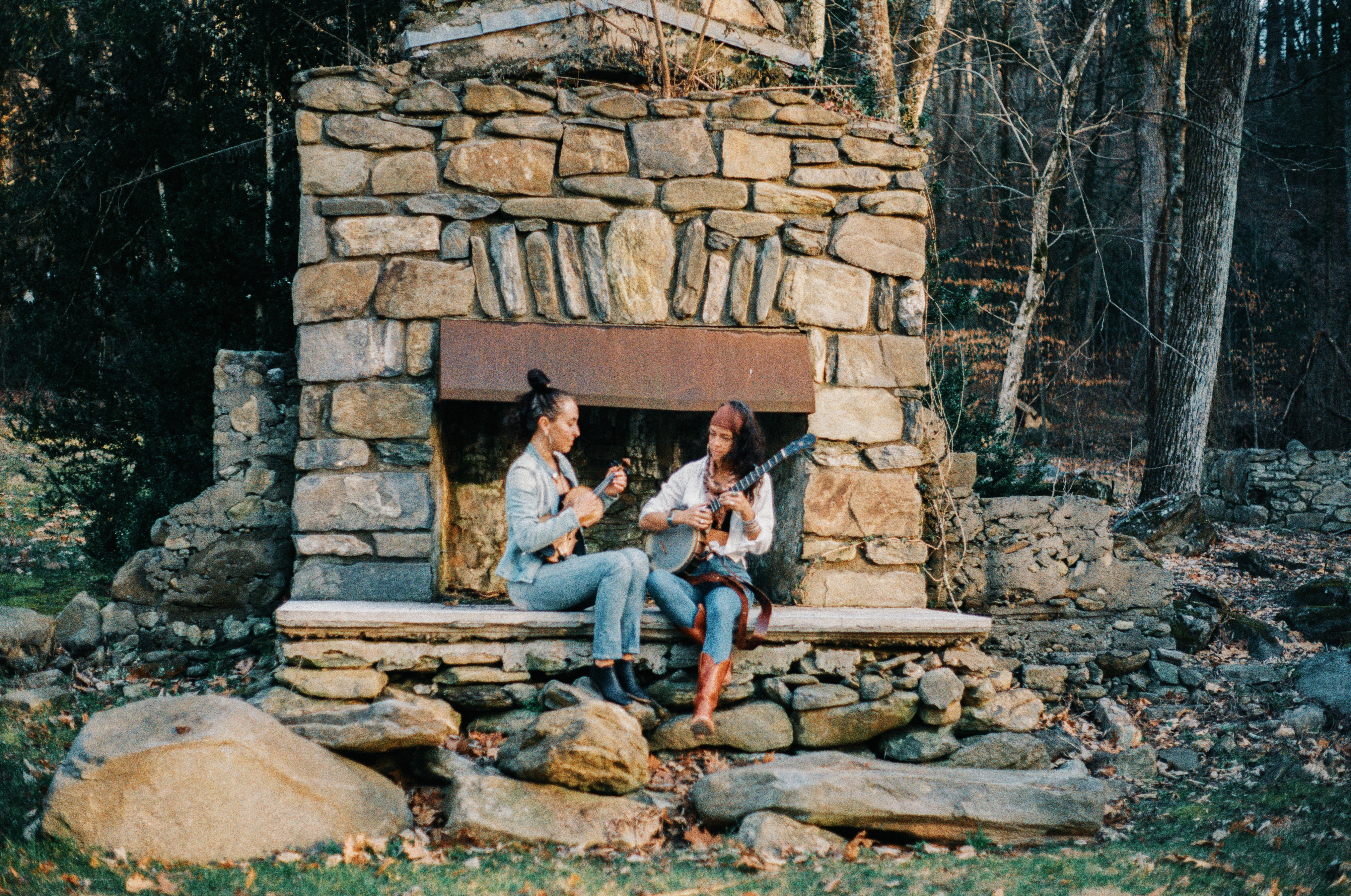
In 2006, sisters Leah Song and Chloe Smith released their debut album, Leah and Chloe, under the name Rising Appalachia. With a nod to their Atlanta roots and musical upbringing (a childhood steeped in Appalachian folk music, soul, and hip hop), the duo aimed to create a sound all their own. Seamlessly weaving world music, blues, folk, Americana, and spoken word, Rising Appalachia’s albums have featured a rich blend of traditional songs alongside contemporary originals, with many of the tracks bolstered by longtime band members David Brown (baritone guitar, upright bass), Duncan Wickel (fiddle, cello), and Biko Casini (drums and percussion). Offstage, the band members are deeply involved in social activism, and have long advocated for a more environmentally-friendly, community-based, sustainable method of touring.
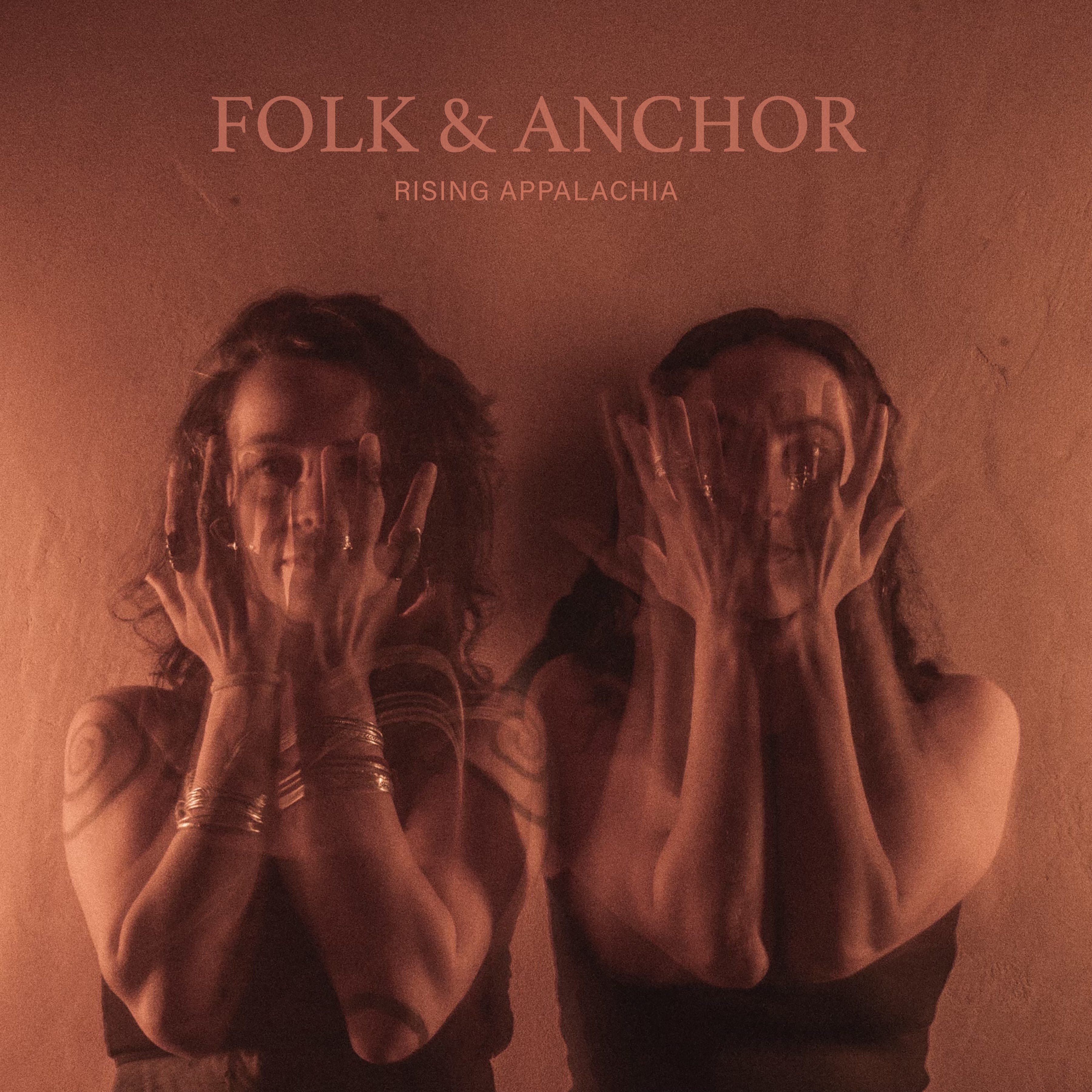
This year marks a watershed moment for the band. After nearly two decades of constant touring and recording, Rising Appalachia is taking a break. Referring to it as a “creative sabbatical,” they will spend the rest of 2024 recharging. But before the official pause begins they’re sharing one final gift with their fans: a new album, Folk & Anchor. Their first record consisting entirely of cover songs, it features remakes of tracks by a wide array of musicians, including Bob Dylan, Willie Nelson, James Blake, Erykah Badu, and Beyoncé, all done in Rising Appalachia’s unique world-folk style.
The covers are a glimpse into the innumerable diverse artists whose work has influenced Song and Smith since their childhood. When asked to name artists she’d like to collaborate with in the future, Song ticks off a distinct roster. “Willie Nelson, definitely on the list,” she says. “André 3000, the Outkast crew, which was a huge part of our upbringing. We would love to collaborate with James Blake, as well.”
Song recently chatted with me over Zoom from South Carolina, where she was spending some time after wrapping up a short tour, and we discussed the band’s latest album, their vision for a “Slow Music Movement,” and how she and her sister avoid burnout.
Creative Reverberations is a reader-supported publication. Each interview takes many hours of work. To read all posts and support ad-free, independent journalism, please become a paid subscriber.
SANDRA EBEJER: You and your sister harmonize together so beautifully. Were you raised in a musical family? When did you begin playing music?
LEAH SONG: We were raised in a very musical family. We’re here actually [in South Carolina] with our mom and she doesn’t go anywhere without her fiddles. Our folks were really into vintage jazz and blues and Americana folk when we were kids. That would have been in the early ‘80s. And when we were both quite young, our mother got interested in the Appalachian fiddle traditions. She became sort of a hobby Appalachian musicologist. She wouldn’t call herself that, but she just started following the Appalachian fiddle camp music everywhere she could find it. So we grew up with band practices in the house and folk music camps on many, many weekends. She wasn’t a professional musician; that’s just what we did as a family. We would go all over the southeast and spend time learning and listening to all these old Appalachian folk tunes. It was a very cool way to grow up and it was much later on that we realized what a special tradition holder she was and is still. She plays five hours a day sometimes.
Wow! At what point did you two decide that this was going to be a career path?
Way later. I mean, as kids we loved it, but it was what our parents did. And then as teenagers, we didn’t like it at all and we really rebelled from it. Then we both picked up fiddle and banjo in our early 20s just to feel connected to our family. It was probably not for a chunk of years, well into our 20s, that we started being invited to perform more often. We were very resistant to that for the first few years. And then the invitations kept coming. I don’t know. I still think we're not sure if this is our career path even though we’re solidly 15 years in, but the invitations keep coming. That feels good.
Your new album, Folk & Anchor, is a collection of cover songs. When you’re pulling together an album like this, is it difficult to narrow down which songs to include? What is that process like?
It was a fun project because it’s the first time we’ve ever done a collection of covers. We’ve really prided ourselves in working with traditional music, which is very different than a cover, and finding new interpretations of very old music from all around the world. Or writing our own music. That's been our path for 8 albums long. And this was a light-hearted idea: What would it sound like if we did a collection of covers? Because our influences are pretty wide and unusual. We never know how to talk about our musical influences because it is everything from Erykah Badu to Willie Nelson. Our scope of folk music is a fabulously wide study. So that was the inspiration. It was like, “If we cover songs that have been really influential to us, then maybe that will tell the story better than words will.”
We had so much fun parsing together which songs [to include]. It felt really important to do Erykah Badu, because we’ve been listening to her since her origin in Atlanta, Georgia as young women. She’s the original Queen of Soul for us, for our generation. Willie Nelson is Chloe’s number one artist that she’s wanted to collaborate with her whole career. Hozier and Maren Morris—we’ve been a big fan of Hozier for a long time and actually found the Maren Morris song through our love of Hozier’s Irish traditionals.
And Beyoncé is beginning to present the banjo and the history of the banjo. Her work is obviously monumentally important for the American story and the story of the traditional music of country and zydeco and the Black south, which is not a story that’s as commonly told and feels tremendously important. So when Beyoncé put out a song with a clawhammer banjo on it, played by an old friend of ours, Rhiannon Giddens, we figured, well, what better inroad to be able to cover a Beyoncé song? Our inspiration has always been the banjo, the roots of the banjo, the African and African American roots of the banjo, the Appalachian roots of the banjo, so a lot of them felt really, really natural.
Rising Appalachia’s music is a unique blend of so many different styles and genres. Do you find that as you travel the world and perform with different musicians that your sound evolves?
I think it evolves, but I don’t think it evolves a ton. I think that we really do have a sound that feels true and honest to us, which is this notion of Appalachian and then subsequently Irish and Celtic musical roots, leaning into the influences that have come out of the zydeco, the West African and traditional neo soul of the South. That’s just what we grew up listening to. We grew up deeply immersed in all of those styles. That’s our footprint. But what can we do if we slow this song down and put a backbeat on it, and find a modal key to perform it in? And what happens if we add a little bit of a banjo riff to this? There is a template that works for us, but everywhere we go, I think that we’re influenced and studying. I like to think that each crossroads adds a little something to our story.
You’ve remained independent throughout your career; you haven’t signed with a major label. Why is it important to you to self-finance and manage your own projects?
Great question. We’ve never signed with a label at all. We started a very modest label early on in our career and then realized that was going to be too much for us to take on. So we’ve stayed independent and label-less, which probably means a lot to us subconsciously. But I think there’s a few reasons we’ve really wanted to stay independent. It’s a lot more work, which is not necessarily something that we’re diehard about. The workload is tremendous. But I think because our genre is really hard to pin down, our influences are wide, and our collaborators are wide, it’s always felt important that we don’t get pigeonholed. That’s probably been a little trickier for the music industry to know what to do with us, but it’s been really important for us to tell our own story and for the story to not be a simple one. We have a complex story. So I think part of it is that when we talked to labels, [it was] like, “Let’s get it to go in this genre and you’re going to be the darlings of the blankety-blank scene.” That felt repulsive to us creatively. It would have been great as a business move, but our creativity feels like it’s the boss. And it’s really nice to be led that way and not led by what an industry has deemed important for the moment. So we’ve stuck to the long loner road of the independent artist.
I watched your TEDx Talk on the Slow Music Movement. You share on your website that it “encourages musicians to try out ‘non-industry standard’ ways of bringing music to the world.” Can you expand on that a bit?
We use that catchphrase [slow music] because it’s something that everyone can kind of grok onto. Like, there’s the slow food movement and the slow fashion movement, and we were like, “That motto is what we want to do.” We attached ourselves to that concept, also, to invite lots of artists to attach themselves to that concept, to figure out how to slow down such a fast-paced industry.
For us, it’s meant a lot of things. It’s meant very special, unusual tours, where we’ve toured by sailboat and we did a walking tour that was very powerful. It’s a hope to tour by horse in the not-too-distant future. And we have toured by train in multiple countries, including the United States, where it’s not convenient at all. So there’s the actual slowing down of the music. But also, I think, just the concept of working with venues that have single-use plastic, figuring out how to be in a bioregion so that as living beings we can have a relationship to the local food, the plants, the weather, the climate. I think a lot of touring musicians will just do jet setting one-offs, where you fly all over the place, you’re in different time zones, you’re in different countries. We have had our foot on the brakes on that for a long time. We like to be in a region. That makes the touring slower and harder to put together but much, much more decent on the long haul of the musicians.
And lastly, we’ve had local nonprofits that will come and set up tables and speak to the audience about what’s going on locally in their region, which has built really beautiful relationships for us because we can’t pretend to know the needs of each region. We are on the move a lot. But if we can work with folks on the ground who are doing a lot of local work in human rights, food justice, advocacy for housing, and the myriad of things that we need to be talking about as human beings, then they do that communication and that creates this web of learning for us and for our audience. So all of those things at their absolute maximum create for us what the Slow Music Movement is. But also, just the concept has been important to us, to have a way to communicate that we want to try and make this as emotionally, environmentally, and creatively sustainable as we can.
All of this work—touring, community-building, activism—can be exhausting, especially if you’re an independent artist without the backing of a label. How do you and your sister ensure that you don’t get burnt out?
Well, there’s a lot of answers to that. We are pretty good at saying no, and we always have been because I don’t think fame has ever been our agenda. So it’s easy for us to look at a calendar and a proposed tour and say, “Well, we could do that big Saturday night show, but we’re going to be in Yellowstone. So we could also take that day off and spend the entire day in one of the nation’s greatest parks.” That’s an easy thing for us. Our whole crew, the whole band, every member is like, “Let’s not do the gig and let’s go to Yellowstone!” So we’ve always been good at saying no.
We are all walkers; we stay in neighborhoods and we’ll take some time before or after the show to be on foot a little bit. We travel with copious amounts of herbal tea and adaptogens and bring our herbal community out to as many shows as we can. Local herbalists are a really wonderful fan base.
And this album is releasing at the top of a creative sabbatical for us. We’re experimenting with taking a chunk of time off in a way that we haven’t really done before. It’s nerve wracking, but it feels like it’s exactly what you just said—it’s an effort to be preventative about burnout and make sure that we’re nourished and sturdy and feeding our muses. I think that we are also slower than a lot of musical ensembles and we’re okay with that.
Your sister had a baby who accompanied you on tour last year. As life evolves and you enter new eras of your personal lives, do you find that you’ve had to change how you make music?
Yeah! She’s sort of been in sabbatical mode for quite a while. I mean, if you could call early motherhood sabbatical. She probably would not call it that. You know, we are both songwriters, but I would say, with a lot of pride, that Chloe is our dominant songwriter. She really writes a lot of our music. And I’m really curious to see how motherhood is going to reflect in her songwriting, because that’s such a pivotal life change. We have a lot of the new material roughed out for the next album, but it’s still in its early architecture stage. And I’m so curious to see how we will record it—if we will stretch it into a longer process. We’ve usually just recorded over a week or two and put together an album.
Do you ever have creative blocks or feel creatively stuck? And if so, how do you break through that?
I have had some big creative blocks. There were a few years when I really wanted to quit touring and go back to graduate school. This is what’s wonderful about having a partnership. For a few years, when I was very low in energy and vitality, Chloe was on fire. She was like, “I’ve got it. I’m writing. I’ve got cool ideas. I’m gonna haul this thing.” On the flip side, when she’s been on these last two years of motherhood and pregnancy, I’ve been like, “I’ve got it. I can pull this forward.” So there’s a beautiful thing in partnership.
But, even before that, this era when I was like, “I don’t know if I can do this anymore,” was close to when the pandemic happened. In my mind, I was like, “I want to quit. I want to become a potter and live as a hermit in a studio on top of a mountain alone.” And the whole world shut down! That was really life changing for all of us, but probably for many of us working artists who were on the edge of burnout because A, we got some rest and B, we realized that being in and of the people is a really wonderful life force. It’s a really special thing to call our job, our purpose, our path. And I realized how much I didn’t want to take that for granted and how much I didn’t want to burn out. I wanted to figure out how to channel it so that it would be a long haul. So that’s part of where this sabbatical has come from: Let’s make sure we don’t get to burnout. Because it’s hard to recover from burnout. It’s a lot easier to recover from exhaustion if you haven’t gotten all the way to the bottom of your reserves.
How will you be spending your time during the sabbatical? Do you have any specific creative projects that you’d like to tackle?
We have a pretty amazing, robust crew. We travel with three other musicians and a two-person crew, and we’re really a family. So just saying, “We’re gonna have a year off” felt daunting, I think, for all of us. We have crafted it as personal time off, but also writing and recording time. So it’s a sabbatical-slash-studio year. That gives us something to lean into, so it doesn’t feel quite as nebulous.
I’m really curious and excited to see what is going to happen, what amount of creativity will come, what amount of rest will come. I don’t feel like we’ve quite gotten there yet. We’re finishing the shows that we had on the books and that feels wonderful. And this new album feels really fun. And then the rest is going to come. Will we feel stir crazy? Will we feel lit up? I don't know. It feels fabulously exciting.
To learn more about Rising Appalachia, visit their website.
This interview has been edited for clarity and length.
You might also enjoy…

