


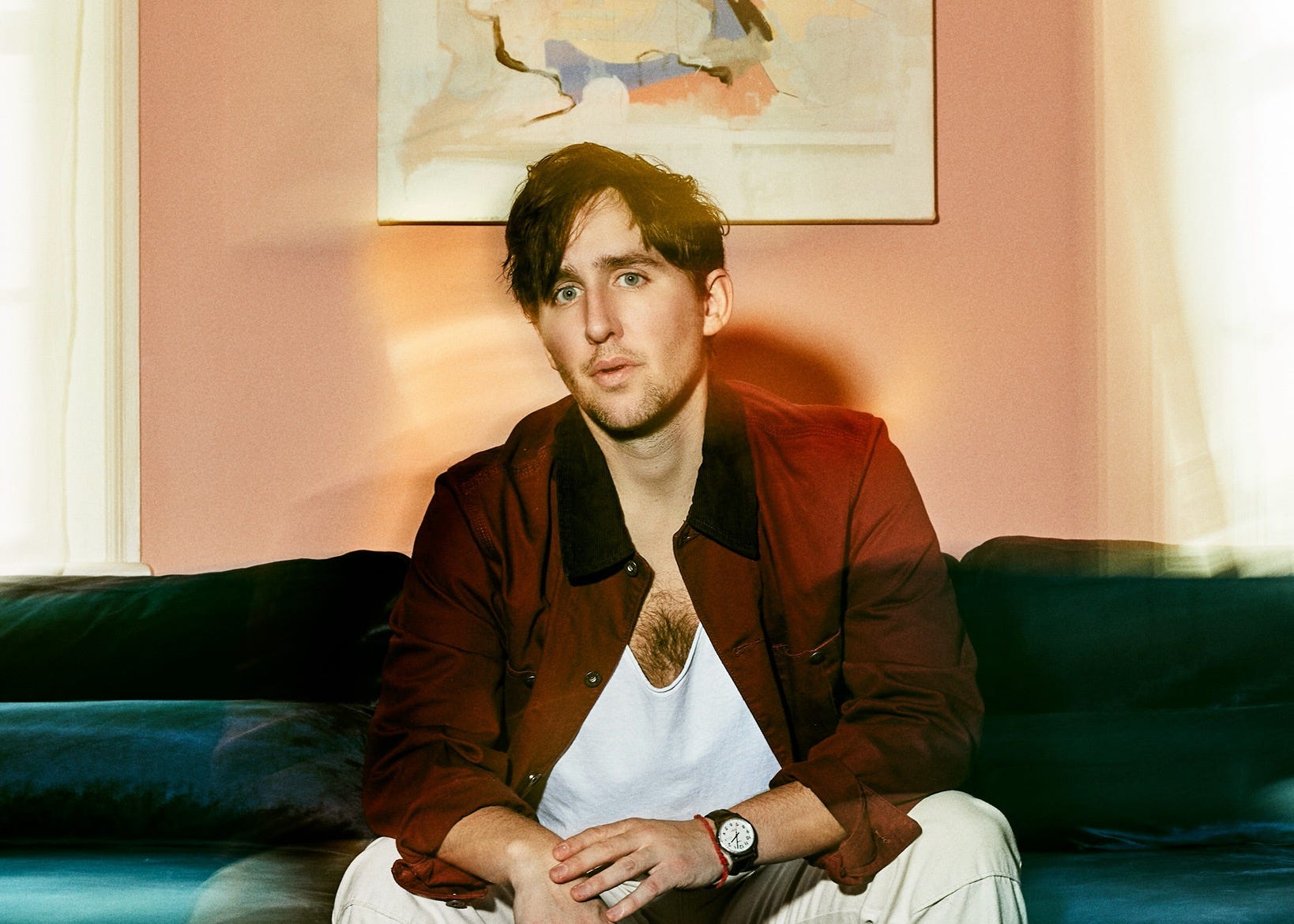
The French painter Georges Braque once said, “Art is a wound turned into light.” Nowhere is this more evident than in singer-songwriter Jack Manley’s new album, Unmeasurable Terms. Written over the course of a 30-day stint in rehab, the four-song EP is the culmination of Manley’s years-long struggle with drug addiction and depression. “I had sworn off music,” he says. “I had sold, given away, or pawned most of my equipment. I hadn’t released anything in years. I had given up. I felt like I failed in the music business. I felt like I failed in life. I just wanted it all to go away. I wanted my past to go away, and in retrospect, I wanted to go away, which is a difficult thing to admit, but it’s true.”
Each of the four tracks on the EP traces a stage in the addiction and rehabilitation process, touching upon codependency, relationships, and a longing for self-acceptance. Manley says the writing of the songs, as well as sharing them with his fellow patients in rehab, was enormously cathartic and a crucial step in his recovery. The other patients, he says, “provided such positive affirmations that I needed, having lost relationships and opportunities due to my addiction over the years, which I never realized was because of that. I always thought it was because of me, that I was bad, or I wasn’t talented enough or I was delusional, or whatever story I would tell myself. When in reality, it was like, dude, you blew a gig in front of the president of a label because you were high on heroin. So yeah, I got this tremendous amount of clarity and positive feedback that really woke something up in me.”
From his home in New York’s Hudson Valley, Manley spoke with me over Zoom about the making of the EP, his influences, and the process of transforming his pain into music.
Creative Reverberations is a reader-supported publication. Each interview takes many hours of work. To read all posts and support ad-free, independent journalism, please become a paid subscriber.
SANDRA EBEJER: I read that you’re a self-taught musician. How did your career come about?
JACK MANLEY: It came about due to a love for and deep interest in music, but I think mostly a need for some sort of self-therapy. The first [instrument] I ever got—and this is gonna make me sound like Oliver Twist or something—was a bass, but it only had three strings. It was electric and I bought it for $40 from a friend. I grew up pretty poor. My father was an Irish immigrant. He passed away last year. Growing up was hard, and music was always a reliable escape and a way for me to understand and connect with these big emotions I was having. I was from this Irish Catholic [family]—you don’t talk about how you feel, you don’t express how you feel, and I felt like a bit of an outcast in my family.
So I got the bass, and I tried playing with other people in high school. But everyone, for the most part, was really into the hardcore scene. I love a lot of hardcore music, but it’s not what I wanted to play. It wasn’t until my freshman year of college when I started playing in earnest, and that’s when I wrote an EP called Hurry Up from my first band, Cosmonaut. That’s really where my musical journey started. The guys in Cosmonaut were so good. I learned tremendously fast by playing with people who are so much better than me.
When you were first starting out with Cosmonaut, who were some of your influences?
The Smiths were a big impact. Deerhunter—their record Microcastle had come out right around then. I might have been high on ecstasy, but I remember putting on headphones and hearing “Cover Me (Slowly)” by Deerhunter and it was like a spiritual experience. The first Interpol record, Turn On the Bright Lights. A lot of post-punk shoegaze [like] My Bloody Valentine. We loved the Strokes. Elliott Smith. How I gauge my output [is] I put it up next to that stuff, and I’m like, “Can this hold weight in a mix next to a Strokes song, a Deerhunter song, a Wilco song?”
I remember—this is a funny memory—being in the fifth or sixth grade and my brother was like, “It’s time you started listening to good music. Music is important. You have to develop a taste.” And I was like, “I do listen to good music! I have the new Third Eye Blind record and I have Smash Mouth.” And he was like, “No, no, no, no. That won’t work.” He gave me OK Computer by Radiohead. And hearing that as a child forever imprinted on my head, “Okay, you take an acoustic guitar, you take an electric guitar, you smash it together.” That gave me the nuts and bolts of what I believe songwriting should be about.
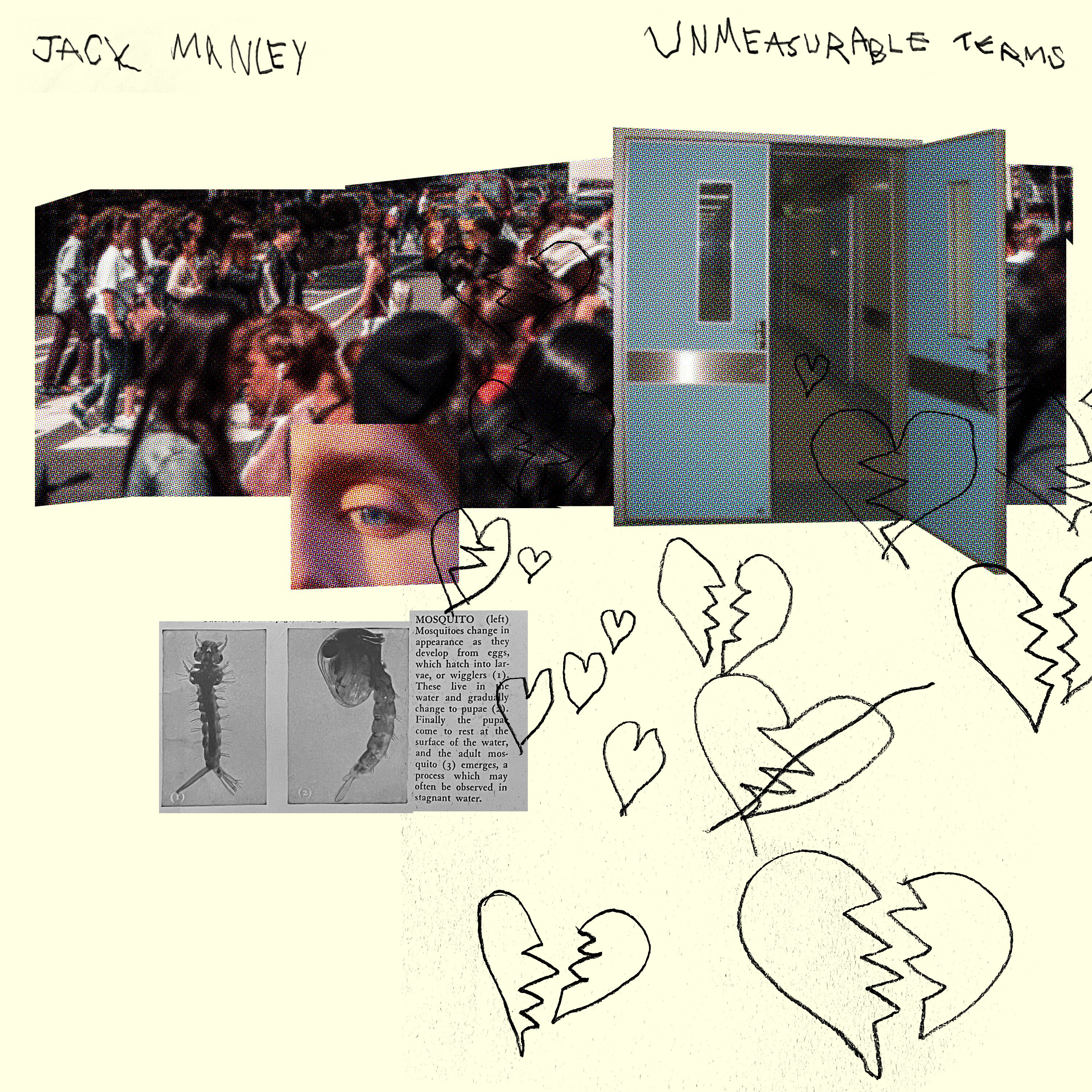
Unmeasurable Terms was born out of a really challenging time. Can you talk about all of the things that came together to make these songs happen?
What brought me to the record was years of frustration and pain and not expressing myself. What more acutely birthed the record was I had two near-fatal overdoses in the same night and was hospitalized twice—brought out on a stretcher in an ambulance, twice, on the same night.
I got to this hospital—this was now my fifth, I think, attempt at rehab—and I was like, no more fancy rehabs. I’m at a state hospital, in a psych ward, for 30 days. It was maybe two weeks where I could barely read. I could barely talk. I remember speaking with my sister; she said she would cry every night after talking to me because she thought I was brain dead. I was slurring my words, speaking very slowly, really fragile and medicated. But eventually I found a beaten up four-string acoustic guitar, so it was missing two strings, and I started to play it. I happened to be in the hospital with a retired music professor. We struck up a friendship and he was hyper critical of me and took me under his wing, even though I didn’t ask him to, as his student for the month. And he’s like, “Okay, we’ll have lessons every day.” He would go over my lyrics and make me write. I got such a kick out of it. I thought it was so funny.
I dabbled for a moment and then I stopped. And I remember a couple people came to my door and were like, “Here’s the guitar. Will you play?” And I was like, “What do you mean? Leave me alone.” And they were like, “We’re stuck here, too. It’s helping us. Please, will you play for us?” I found that to be really moving, that it affected people so much. I remember playing one of the songs that ended up on the EP. I turned around and this guy was bawling his eyes out. And it was someone who, if you were to look at us next to each other, [we were] two very different people from very different worlds and very different lived experiences. And he was so moved by what I was saying and what I was playing.
All of these cues—some subtle, some not—woke me up. I got out of the hospital, and reached out to a friend I grew up with who is a genius musician, Billy Pearson. I shared the songs with him, and he was like, “This is really powerful stuff.” We started playing together regularly, going every Monday to this open mic at the Colony Café in Woodstock and sharing the songs there. And again, every time we would perform a song, the entire room would light up. The music, which I feel like I can only take so much ownership of, seemed to be speaking to people. From there, I reached out to my friend Josh [Eppard], who’s in a band called Coheed and Cambria, and he was like, “Yes! I’m in. Let’s do it now, while I’m home from tour.” So we recorded it pretty quickly. I was only out of the hospital, I think, for a month and we were already in the studio. It’s been a pretty wild experience.
Each of the four tracks on the EP represents a stage in the addiction or rehabilitation process. Did you begin writing knowing you wanted to have that theme, or was it only after you began the writing process that you saw the theme emerge?
A little of both. It was an organic process. Lyrics come to me automatically and I try not to think about it. If I’m thinking too much, I’m usually cut off from wherever it’s coming from. I’ll typically only gain insight in retrospect and then use that to guide other decisions. I mean, it was very clear what the material was about, but I would say some of the greater insights still come to me. Like I was playing “Unmeasurable Terms” for someone today and just hearing this one lyric, “My peace has cost them all their own,” made me cry. And I wrote it! I’m far enough removed from it, but God, it leveled me this morning, just thinking about it and how honest, simple, and direct of a message that is. I feel really good that I have been able to distill years of anguish [into the music], but at the same time, it’s heavy. I still feel, sometimes, a lot of shame. It’s interesting—I blew up my life and I got these beautiful songs to show for it. It’s this interesting duality.
How are you doing now? Are you in a better place, physically?
I’m doing a lot better. Something I’ve learned, through a lot of trial and error, is it’s not anything that goes away. The scar gets imprinted on your being. The pain, the shame, anxiety, and depression—for me, it doesn’t go away. But I found a better way of dealing with it, and I’ve realized, through the help of other people who’ve been there before, that I’m not alone, and I’m not worse than anyone else. I used to think, “I’m so bad. I’m so terrible. I can’t be fixed.” To learn that I wasn’t this terminally unique case was actually quite uplifting. Like, no, you’re actually just a basic boilerplate drug addict. You’re not a bad guy, you’re just sick, and you’re not getting better because you’re not doing the things you need to do to get better. That really helped ground me in reality and make me feel like progress is possible.
There’s some interesting visual imagery that you’ve used for this album. The single art for “Tightrope Life” includes text describing the medication Narcan, while the animated video for “Smack Water” has some really dark stop-motion visuals. How much were you involved in that aspect of the album?
I want to give a shout out to Eric [Weiner] from the Wild Honey Pie and Andrew [Colin Beck, director], who made those pieces. Yeah, I was heavily involved. I requested certain items to be placed in, like the text about Narcan and putting Narcan in the video. I wanted to create, with Andrew and Eric, a visual world in which the songs could live. I wanted to make sure there was substance there, that you could bite in and find little Easter eggs. Even at its greatest abstraction, a visual still may be very directly, literally, speaking to the lyrical content.
Are you continuing to write new music? What are you writing about now?
I was actually just in the studio and recorded six new songs. Some of it is still contending with some of those issues, but not in the same way. I’m at a stage where I’m aware that I can’t keep writing about that; it’s time to move on. And that feels good. I guess I’m still finding my way. I know it’s not going to be as directly related as the EP is, of course, but I think there’s still going to be some through lines that inevitably carry over to the next release, which I think is going to be another EP before I make a full-length album. I feel like I’m still getting my footing as an artist again.
Is there any advice you could impart to anyone who is battling addiction or going through a difficult time?
Get help right away. Anything and everything is possible as soon as you are okay. So, whether it’s a job or a relationship or a band or something you’re afraid you’re going to lose, you’re going to lose everything if you don’t take care of yourself first. Whatever the stakes are, just go take care of yourself. It doesn’t have to be as dramatic as what I went through. You can start going to an outpatient program. You can check out an AA meeting. You can see a therapist. Just take action. Besides that, listen to the feedback of your loved ones. If everyone’s telling you something’s an issue, they’re not all wrong. You should listen to them. And know that healing and recovery and redemption is all possible, it’s all there for you. You just have to change your narrative. If you’re sick, you have to get better. That’s it.
Now that this album is out, what’s next for you?
I’m going down to [New York City] in a couple of weeks to do some additional production and then mix my next EP. Besides that, I have some shows coming up. And I’m trying to figure out what to do visually. I would love to showcase the band more. We have this beautiful barn behind my house that we rehearse in, and I think it would be cool to invite people into that world. Additionally, since the first day of recording this EP, a documentary has been in production about my story, its relation to Josh from Coheed’s story, where everything intertwines. We’re still filming. That’s something to look out for in the future. So there will potentially be a full-length documentary about all of this.
The idea of putting it all out there in song is one thing, but a documentary is a much bigger project. How does it feel to share this deeply intimate period of your life so openly?
There’s moments where I certainly question my sanity. But at the same time, what I’ve learned is the more people who know about my past and present issues, the safer I am and the more I’ll have to be honest and transparent. I don’t have to worry about this underlying secret. I can’t believe I’m about to say this, but you’re only as sick as your secrets, right? It’s a great litmus test: if anyone isn’t down with someone being human and making a lot of mistakes and then trying to fix it, if you actively want to reject that, that’s on you. I’m doing what I need to do to make amends. And it’s scary and it’s vulnerable. Again, at times, I can get in my head a bit and be like, “Oh, my God, what am I doing?” [Laughs] But, overall, I think it’s ultimately brave and I think it’s smart for my recovery.
I agree that it is very brave. It goes against that Irish Catholic upbringing of not wanting to talk about anything.
Yeah, totally. It’s the most antithetical thing, but it goes back to recovery. The first thing they told me was, “You have to admit, deep down, that you’re an addict and that you’re sick. Otherwise, none of this is going to take.” And that just went against all of my instincts for self-preservation and survival and how I was taught. [I was] like, “I’m strong. I get through things with willpower and brute force.” That’s how I achieved a full ride to a good university. That’s how I achieved anything in my life. But the thing is, a lot of these coping skills and strategies, they work for a period of time in our lives and then they stop working. Because life isn’t this one size fits all thing, right? Otherwise, everyone would just have a giant upward trajectory in their lives. So you learn, “Okay, this thing that used to serve me no longer does. So now I must change.” And through that change is the growth but is also the pain. You gotta learn to love the pain, I suppose.
To learn more about Jack Manley, find him on Instagram and YouTube.
This interview has been edited for clarity and length.
You might also enjoy…

