

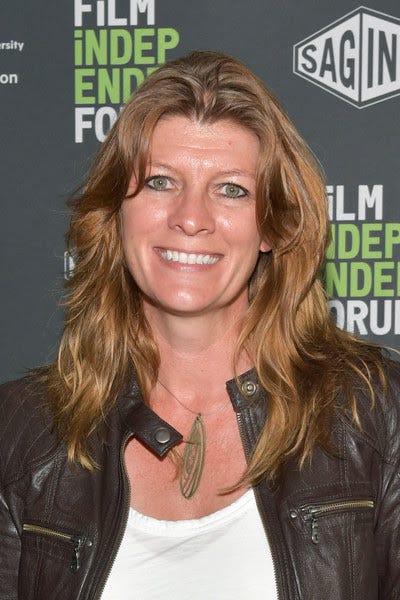
CR 013: Skye Borgman on the Art of Documenting True Crime
The award-winning documentarian discusses her career, her approach to filmmaking, and her latest project, Netflix’s “American Murder: Laci Peterson.”


Truth, as they say, is stranger than fiction—something that Skye Borgman’s work proves time and again. In 2019, Borgman—who had already been working professionally for years as a cinematographer and director—became a viral sensation after Netflix premiered her true crime documentary Abducted in Plain Sight. The film, about a girl who was kidnapped twice by a family friend, was an instant hit, generating thousands of headlines and Tweets of the “how can this possibly be true” variety.
Over the past five years, she’s directed a number of riveting true crime documentaries, including Girl in the Picture, Dead Asleep, Sins of Our Mother, I Just Killed My Dad, and The Truth About Jim, as well as episodes of Trial by Media and Unsolved Mysteries. Her latest project, American Murder: Laci Peterson, is a 3-part miniseries that premiered on Netflix on August 14th.
Despite being known primarily for her work in the true crime realm, Borgman says that her films are about so much more than sensational misdeeds. “I’m not in the business of doing crime stories, necessarily. I’m in the process of doing human stories. I feel that crime stories give you the full spectrum of humanity. You see the very best of people, you see the very worst of people, and you see everything in between. I love that about crime stories, seeing how people respond to things.”
I recently chatted with Borgman over Zoom about her career, how she gains the trust of her film subjects, and the importance of setting personal boundaries.
This is a benefit for paid subscribers. If you’re interested in reading this and hundreds of others in the archive, please upgrade to a paid subscription. It gives you access to inspiring interviews, and helps me keep the lights on. Win-win!
SANDRA EBEJER: How did you get into this line of work? When did you know you wanted to be a filmmaker?
SKYE BORGMAN: I look back to what I was interested in as a kid and as a teenager and what I thought I wanted to do, and theater was something that was interesting to me. I love this process of public storytelling. I grew up in a small town in Oregon, and I never in a million years thought I could make movies. I didn’t even think that was a career choice that was available to me. I loved watching films, but it didn’t feel like that was a job that existed. I went to college, to an art school in Seattle, and even then, there were some video-making classes, but it was really a theater-based school.
I ended up doing the classic post-college European vacation and fell in love with these other places, and my worldview started opening up a little bit. It was really at that point that I started thinking about taking photos and chronicling this journey that I was on, and that’s when documentaries first started to enter my consciousness. I thought, “This is something I could really love doing, public storytelling and traveling and logging it in a photographic kind of way. I guess it’s documentaries. I guess that’s what I should be doing.” So I came back to the United States and went to film school at USC, and then spent the next almost 20 years as a director of photography, filming both documentary and scripted works. But I knew that it was really the documentary world that I loved, and that’s what I wanted to throw myself into. It was a long way of getting there, but always knowing from the beginning that dealing with real people and telling those stories was interesting.
Who are some of your influences?
Barbara Kopple, certainly. Lucy Walker. Errol Morris. All of them, I think, are really pushing boundaries with storytelling. I think documentaries overall have just such an open canvas to work with. I guess scripted does to an extent, but there’s so many different ways of telling a documentary based on what story elements you have access to, and I think those filmmakers do that in a really interesting, evocative, groundbreaking way.
The story told in Abducted in Plain Sight seems so far-fetched, but the film is riveting. How did that project come about?
Keep reading with a 7-day free trial
Subscribe to Creative Reverberations to keep reading this post and get 7 days of free access to the full post archives.