


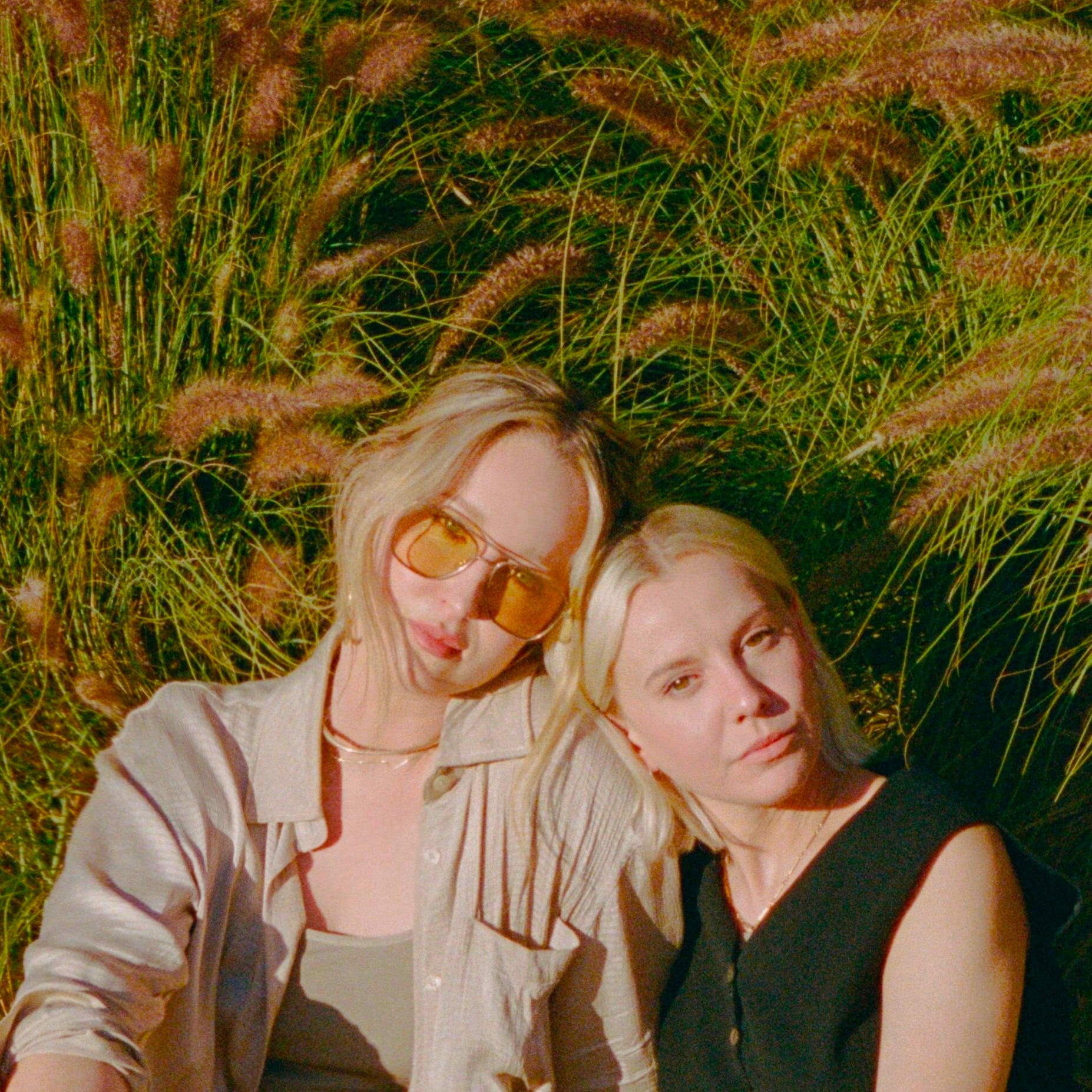
It’s been less than a decade since longtime friends and former roommates Grace Coates and Rachel Ruggles—better known to listeners as Gracie and Rachel—released their self-titled debut album. Yet in that short time they’ve become one of the most critically acclaimed indie musical acts working today, thanks in large part to their distinct blend of orchestral pop. But a few years ago, after the release of their 2023 EP Nowhere Now Here, they were struggling, going in different directions musically and personally, and unsure if their partnership would continue.
“I was really wanting to make a record,” Gracie says. “I had songs that were brewing. And Rachel was going into this world of sound design and Foley and learning this new skill set. It was me trying to pull her into this record cycle that she just wasn’t in the place for. I went off on my own and recorded a couple of songs with our producer, Benjamin Lazar Davis, and we made work that I would never have put into the Gracie and Rachel camp.”
Eventually, once Rachel was ready to put work into a new album, the duo decided to try a different approach. “We had this epiphany. What if Rachel does four Rachel songs, Gracie keeps her four Gracie songs, and then we do four collaborative Gracie and Rachel songs?” Gracie says. “That was a cool new way of doing things, but it came from a challenging time of, ‘Are we going to break up? Is it over? Does this mean we’re just going our own way?’”
The approach wasn’t always comfortable for Rachel, who admits that the album was the most challenging she’s worked on. “There were days where I was like, ‘I don’t think I can come up with four songs.’ It felt daunting and scary, and I was pretty emotional about that element. Also, I was separating from my partner, so I had lost that other support system. Gracie was going off doing her own solo music and I left this partner that I was living with. I think both of those happening had a lot of influence on the music and the difficulty of making the record.”
The resulting album, If We Could, Would We, is a gorgeous collection of songs covering deeply personal topics—regret, loss, and the pain of accepting that growth requires change. Over Zoom, Gracie and Rachel discussed the making of the album, their similarities, their differences, and how they shaped their unique sound.
Creative Reverberations is a reader-supported publication. Each interview takes many hours of work. To read all posts and support ad-free, independent journalism, please become a paid subscriber.
SANDRA EBEJER: The press release for the album describes you as a Venn diagram. What do you think that diagram looks like? In what ways would you say you overlap and in what ways do you differ?
GRACIE COATES: Rachel and I have, for the past few records, been in the middle one together, and I feel like this record is the first time we are going out of that and getting on our own page while still being together here. I think that’s where the Venn diagram does feel fitting, because we’re getting a bit of separation between church and state, between Gracie and Rachel itself. We’ve been one person, in a way, as a band, and on this record, we were allowing ourselves to be three people—Gracie and Rachel is one, Rachel’s one, and Gracie is another.
RACHEL RUGGLES: We have so much in common, but we’re also polar opposite people. One example from the music on the record is two of my pieces are slow and minimalist and instrumental. My background is as a violinist, and I have always been more of the arranger and instrumental composer, and Gracie is the songwriter and lyricist. I think it’s great that Gracie got to lean into more of her individual songwriting practices, and we got to also share slower, sparse, composition-style pieces. I think we kind of live in opposite ends in that respect.
You come from such different musical backgrounds. Was it difficult in the beginning to shape your sound?
RACHEL: I remember it being challenging. I come from sitting in front of a music stand with sheet music in front of me, and I recall when Gracie invited me to play with her, I was like, “What am I supposed to play?” I had never used my ear or my mind in that improvisatory, write-your-own-music kind of way. So that was a really big challenge for me to break out of this [mindset of], it’s all prescribed and do what you’re taught. And I remember Gracie being like, “Just play anything.” And I’m like, “What’s anything?” [Laughs] She would hum things and I’d be like, “Okay, I can play that.” It was like baby building blocks for me.
GRACIE: It probably was more challenging in Rachel’s mind for her, but the way I saw it, Rachel was so natural at it. I remember saying multiple times to my mom when Rachel would leave, “How does she know exactly how to express what I feel like through sound?” Because I didn’t have the language. Rachel came from this theoretical thing, and she’s like, “Tell me which notes to play.” I’m like, “I don’t really know what notes are. I’m still figuring it out.” But I felt like there was a symbiotic, unspoken thing between us, where I did feel like she knew what the song needed or what timbre to be in without us really being able to articulate that. Her sense of intuition was stronger than it probably felt for her, because she was like, “I need the notes on the paper.” But I think there was this natural thing that we didn’t really have to talk about it, and that was the coolest thing, because we both didn’t know how to speak the other person’s language; we could only do it through sound.
The songs on the new album are so personal. With the tracks you wrote individually, what was it like when you first shared them with the other person? Did it open up any wounds?
GRACIE: I think we were both terrified to show each other for the first time. I remember Rachel held on to hers for a while. [To Rachel] You didn’t show me for a bit, and I also was nervous to share them with you. I remember, actually, the first time sharing two of them with you, and my heart was beating out of my chest.
I had, not that long before, done for the first time a solo set upstate, and Rachel came, and I felt like my heart was outside of my body. Because I normally stand next to this person. I don’t ever perform for her; I perform with her, and she’s watching me now. It was like an out of body experience and you’re floating above yourself. So there was a little bit of that, at least for me, when I was sharing the songs.
She was so supportive and we were both so encouraging of each other, but terrified. “Undertow” I was scared to show her because it was explicit lyrics about our relationship. And Rachel’s really funny, because she listens deeply to these things, but then months later, I was like, “Did you ever listen to the lyrics?” She’s like, “Yeah. I know what it’s about, Gracie.” And I was like, “Oh, okay.” I didn’t know because we weren’t talking about it! It’s a part of what I think got the title, when Rachel had this concept of, if we could, would we. Like, if we could, would we do this differently? Would we go back in time and be a band again? Would we do it the same way? Would we not do it at all? There’s a lot of questions and I don’t think a lot of answers on the record.
RACHEL: It’s interesting—I only came up with this thought just now—that Gracie probably would like me to respond more or ask more deeply about the lyrics, and I respond more to the musicality and the instrumentation and the production. And she responds more to my music asking about the lyric, and I don’t really want to talk about the lyric. [Laughs] I remember I shared the one iteration of “Caroline,” which is my only lyrical song, and our manager was like, “I can’t understand what you’re saying. It sounds like you’re hiding.” And I’m like, “That’s intentional!” [Laughs] Then I cleaned up my vocals so you can hear the lyrics. But I do think we both enter into music from those very different places. I’m sure I could ask more about the lyrics, and Gracie could ask more about the instrumentation and the arrangements.
How are things for you now that you’ve put these thoughts and feelings out there?
GRACIE: I think we are in a better place from it. I think we’ve been gentler on each other. Like, the other day, Rachel’s like, “I gotta make a whole record of this piano music” or something, because she has these songs on the record that I love so much, and she had a really great time exploring. And that would have threatened me years ago. I’d be like, “Well, can I be a part of that? I can play piano!” I would have an ego flare up of some kind. I think we’ve allowed each other to say we can make all different kinds of things, and we do a lot of great things together and when that makes sense, let’s do it. It makes it more intentional. That is why I’m really grateful that Rachel said no about it at first, because I think we would have felt the pressure to make something else, and it might not have pushed us into new territory as much as this album did. So in that sense, we’re a lot better.
RACHEL: I think it helped remind ourselves what we are good at doing together, and what we’re good at doing alone. And that’s any partnership. You can’t be good at everything together. In some ways, it was able to spotlight where we thrive as collaborators.

Did the way this album was made change anything about how you’ll make music going forward?
GRACIE: Yeah, for sure. I think it’ll make our collaborative work much more exciting and intentional and celebratory and not needing to fit into something that we’ve known in the past we’re good at. I think of Andrea Gibson, the poet. The thing they said when they were diagnosed with cancer was, “We’re taught that our greatest human desire is to be known. Like, ‘He got me the thing for my birthday because he knows me so well.’” There’s this thing that means love and connection and seeing. “I feel seen because somebody knows me so well.” And they were like, “When I got diagnosed with cancer, I realized the power of loving my partner was to unknow them.”
When you’re in partnership with somebody so long—you know, Rachel and I have been doing this since we were 17—I still think of her as the 17-year-old in some ways. I’m sure she thinks of me that way. And it doesn’t allow the other person to grow. I’ve joked that Rachel will get a new sweater, and I’m like, “Why don’t I know about this sweater? I’m supposed to know everything about you!” You tighten your grip and it doesn’t allow the other person to surprise you or surprise themselves, because they think they’re still that person, too. So I love the concept of unknowing each other, and I think through this process we’ve hopefully given each other that and surprised each other.
“Leaving Home is Going Home” is a gorgeous track. In the liner notes, it lists the most incredible roster of backing vocalists: Ani DiFranco, Gail Ann Dorsey, Holly Miranda, Melissa Ferrick, and Jocelyn Mackenzie, to name a few. What was the experience like of having such an incredible group of artists support you on this ballad?
GRACIE: Surreal and beautiful. It was really special, because we conceived the majority of that song when we were in residency in Estonia. We were really isolated out there writing these songs, and that’s where a lot of that idea of leaving home is going home came into our world. So to have this warmth of people you know back home, who we feel so grateful to be in their lives, it felt like a really big hug that the song needed.
RACHEL: But I will say, editing everybody’s vocals... That took some time. People were singing the wrong lyrics. You know, you think we’re professionals out here. Some people did it in their iPhone, which we told them they could do. And I love them all just the same. But oh boy, was that a feat. I did it literally right in this room. I was just nudging, nudging. “Let me line up the yeses.” I pulled people’s words apart.
GRACIE: Yeah, we didn’t do this all in one room. It was everybody individually sending us their stuff. But it was sweet.
Your music is released through Righteous Babe Records, and it’s striking how different that label seems from others out there. A few years ago, I saw the two of you and some of your labelmates perform under the name The Righteous Babes. How was that for you, as young women, to be signed to a label that isn’t really so much a label as it is a community?
GRACIE: I remember thinking, “We’re gonna have to get everything approved. Will they like this if we go this direction?” And we learned early on that there’s a lot of trust in us that they and Ani had to say, “We believe you’re going to make something that we’re going to be intrigued by.” And that was a really big gift, because we have many friends in the industry who have not had that experience and don’t get to put out the things that they want to. So there’s a real trust and freedom in that.
We got to tour with Ani for a long time before even signing with her. She was a sweetheart and a real friend and very complimentary. Just to give an example of how I think the label feels—we would tour with her, and she was in the wings every single song of our set. She didn’t have to do that. We were playing pretty much the same set every night. But she has such care and attention to detail, and she’d comment on how we played something differently that night, or how she liked this story we told or whatever. There’s a real care about the people behind the music, not just the music.
RACHEL: I feel like the general tone is the artist leads, rather than the manager or owner or Spotify. It’s truly “we’re in service to the artist,” and we’ve always felt very supported. We own all of our music. They care about our being able to represent ourselves and have that type of ownership. So, yeah, good people. It’s becoming rarer and rarer.
For a long time, I had your song “Trust” on repeat. It was just one of those songs that I felt like I needed at the time. Are there any songs from any of your albums that you particularly love?
RACHEL: I love “Go.” It was one of our first songs we ever wrote together.
GRACIE: Every tour I’m like, “We could cut ‘Go.’ We played that enough.” She’s just like, “We’re not cutting ‘Go’! That’s not happening! That’s my happy place.” So, there’s songs like that that I think we each feel connected to. “Possible” is a song on our last EP that I really am grateful for and feel close to. It was a little half-song/poem and that was an example of the label being great, because it’s a one-minute-long thing, and they didn’t push us to do more. They let us put it on a record and it’s just a mantra. But that’s something I think is cool about different kinds of songs on the different records that get to come out.
If We Could, Would We finds the two of you working through some challenges. Usually when I’m going through something, I turn to music. Are there any artists or works of art you turned to for inspiration as you were working on this?
RACHEL: My greatest inspiration to make a record is music, hands down. Gracie likes to listen to people’s conversations on the subway—not in a creepy way, but she enjoys being out in the world. For me, it’s always music, music, music. I listen to a lot of different kinds of music, but for this record, as I’ve been getting more into doing sound for film, [I’m inspired by] everyday sounds, the sounds of the street, the sounds in your room, the sounds of silence. That diegetic underbelly was very inspiring to me. I’ve been listening to a lot more ambient music. I don’t listen to as much pop. On the last few records, I was listening to a lot of Christine and the Queens, more energetic music. And I went into a slower pattern, listening to more folk music and modular synthesis music and music that is just sound design and sound manipulation. That was a different sonic environment that I was living in than previous records.
GRACIE: Yeah. That’s totally spot-on that my inspirations come more from the people that I’m interfacing with or the relationships I’m navigating. I was going through a lot of ups and downs in my romantic relationship, our partnership collaboratively, and having a big identity crisis, as far as who is Gracie in and outside of both of those relationships and in the world? I was journaling a lot about that, and a lot of the lyrics for my songs and things I contributed to Gracie and Rachel were me going back to old notes and collecting things that I’ve been storing for a while from an emotional perspective, not so much a sonic one. Rachel’s the one that often inspires me to try to listen to more music, because I can get into my hole and not do that and put on the same old jazz every morning.
Your debut album was released less than a decade ago, and you’ve already done so much. As you look ahead to the future, are there any big goals you hope to achieve?
GRACIE: Score a whole film. That would be really cool. That’s been a longtime goal of ours. We are doing a headline tour coming up, and I think it’s time for us to do more of that and take a chance on realizing that we have built a beautiful group of people that follow our work. To find them out in the wild on tours of our own is something I think is really important. But, yeah, I think just world domination.
RACHEL: [Laughs] With these headline shows coming up, we’re both really excited about playing with a full band. We’re gonna be bringing out a drummer and a guitar, keys, sound sculptor person. I’m very excited about that. And you know, one thought I’ve had for a long time for Gracie and I is to make some sort of live record. We’ve never done that before. I think getting some people in a room and seeing what happens, that’s a small goal that could be different and potentially enlightening for us.
GRACIE: Totally. That’s a good idea. I hadn’t heard about that one, but I really like it. I also think [touring] Europe is something that we want. We just did a tour with Ani last June in Europe, and there’s a real support for the arts over there. People go to see music and come back and stick with you. I mean, we played London probably a decade ago, and people were following along forever and will come to the show if we return. There’s just a feeling of really wanting to get European connections.
RACHEL: I think there’s a feeling of we just want to be European.
GRACIE: There’s that too, yeah. [Laughs]
To learn more about Gracie and Rachel, visit their website.
This interview has been edited for clarity and length.
You might also enjoy…


Great interview! I’m obsessed with this new album from Gracie and Rachel and it’s fascinating to hear some of the context for it.