

CR 099: VFX Supervisor Kevin Lingenfelser on Netflix’s Highly Explosive ‘Man on Fire’
The Emmy Award-nominated visual effects supervisor discusses his work on the action-packed series.

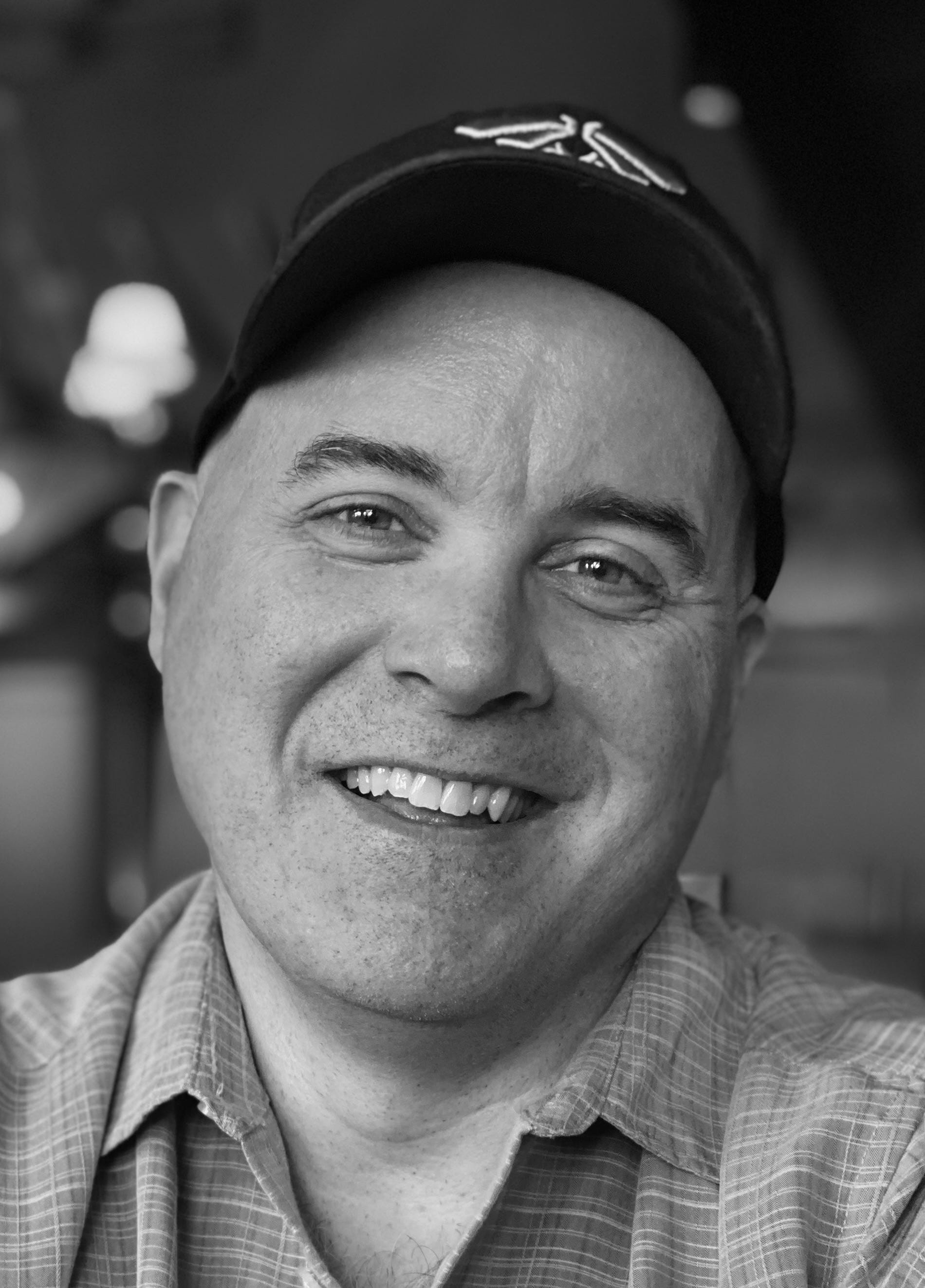
For more than 30 years, VFX supervisor Kevin Lingenfelser has contributed his talents to dozens of film and TV projects, earning three Emmy Award nominations along the way. Over the years, he’s worked on an impressive roster of titles, including The Truman Show, Pirates of the Caribbean: At World’s End, Thor, Transformers: Dark of the Moon, Agents of S.H.I.E.L.D., Preacher, and Armageddon, among many others. His success and longevity in the industry can be credited to his passion for the work. Lingenfelser says he seeks out the projects he’s most interested in, and always aims to finish a job having learned something new.
“One of the things I tell myself at the end of every show I do is if I didn’t walk away having learned something from it, I need to stop doing what I’m doing,” he says. “So every show, I can easily say I’ve learned at least one thing, if not multiple things, about how to do something differently.”
His latest project is Man on Fire, a Netflix series loosely based on A.J. Quinnell’s 1980 novel. Set in Rio de Janeiro, it stars Yahya Abdul-Mateen II as an ex-mercenary who must keep an orphaned teenage girl alive after her family is murdered by terrorists. It’s a fast-paced thriller full of explosive special effects, though Lingenfelser says his goal for the project was to make even the most action-packed moments look photorealistic—so much so that he appreciates that audiences haven’t noticed some of his work.
“The feedback has been good,” he says. “There are certain things that haven’t been commented on, which is great, because people weren’t even aware that we did the scene.”
I recently spoke with Lingenfelser about his many influences, the sometimes bizarre research he must do for his work, and how he and his team pulled off a particularly challenging explosion in Man on Fire.
Creative Reverberations is a reader-supported publication. Each interview takes many hours of work. To receive new posts and support my work, please subscribe.
SANDRA EBEJER: Your first IMDb credit is 1993’s Demolition Man. Did you know from a young age that you wanted to work in this field?
KEVIN LINGENFELSER: I thought I wanted to direct, but Alien was life changing for me. When I saw that film, that’s when I was like, “Oh my God. Where the heck did that thing come from?” I knew then I wanted to go into the visual effects side of things.
I’ve been very fortunate. I’ve been working now for over 30 years in the industry. I’m what they call production-side supervisor, so I no longer work for a specific visual effects vendor. I work for the studios, and then I hire the vendors to do the work. I like being in the so-called driver’s seat. I still answer to producers and directors if it’s a film and a showrunner if it’s television, but there’s a lot of control that I’m able to have over the work and how it evolves and the final result, which I’m a big fan of.
Do you find that each director or showrunner has their own way of working with the visual effects team? Do you have to figure out how to navigate that in order to align your vision with theirs?
Absolutely, yes. Every time I start a new show, one of the first things I want to learn is how savvy they are with visual effects. Are they used to it? Have they done a lot? I look at their reel or their resumes, and I see they’ve had some experience, but not a lot. So then it’s about leading them through the process, especially once we get on set and we start filming. We have a plan in place for why we need to do certain things, because during a shoot, if there’s visual effects involved, we’ll need to collect data. It’s very important to align with the first assistant director, because they control the set and the pace of things, so they have to understand that we have to get data for our shots in order for our work to come together.
It’s critical for everybody involved—makeup, hair, special effects, stunts—to work together, especially when there are shows where a lot of that work mixes and you’re working with all the departments to achieve a final result. It’s not always about just doing a CG [computer generated]-only shot. A lot of times there’ll be real elements that you need to integrate into the final work, and we come in and either add something CG or we augment something. We may augment a stunt; we may augment makeup effects or augment an explosion. It usually happens after the fact, when it’s in editing, but I’m a big believer in getting a real element on film and augment that. Like if there’s a car crash, I’m not going to be one to say, “We need to do that CG.” I will hear what the plan is from stunts, what the plan is from special effects, and if they can do it in camera, I’m all for it.
Man on Fire was a good example of that. There were certain CG shots that we had to do—the destruction of Rayburn’s condo you’re not going to do for real, so we knew we had to do that [in CG]. And anytime an actor is near fire or explosions, it’s a combination of, what can special effects do? How close can Yahya get to that explosion with it being safe? Do we need to shoot him on a blue screen? There’s a lot of variables. We have a plethora of meetings, and we have scouts for a lot of this stuff, but we also have to be able to pivot on the day and change when things don’t go as planned.
Like, now it’s very common for us to do all gun fights and gun hits and squib hits [in CG]. Even on Resident Evil, they just had 3D-printed weapons. They didn’t have an armorer on site, so we ended up doing all the muzzle flashes, all the shell casings being ejected, all the impact hits [in CG]. That was the same for Man on Fire. In the seventh episode, there’s a massive shootout in this hospital. There was a reception desk, and special effects were able to rig the front of that desk with some squibs to blow, but after that, anytime you saw an actor with a pistol or a rifle shooting, that was us. They did have airsoft weapons, so you would get the real slide action on the gun and you would get a little indication of the CO2 dispersing from the end of the barrel, but we still had to add that firing muzzle flash, we still had to add the shell casing ejecting from the side, so it’s a lot of work.
Man on Fire was a good example of all the departments working together to achieve that end game of [making it appear] realistic. With this show, it was important to do more invisible effects. But it is important to gel and work with all the departments in order to achieve the best looking visuals that you can for every show and every film. Otherwise you’re just setting yourself up for failure.
When you’re doing gunshots or something similar in CG, do you do research on how to make it look realistic?
Yeah. When we were doing Resident Evil we were dealing with mutations and things of that nature. The amount of research we did online, we were all worried. Like, if someone’s tracking what we’re looking into, it’s not good. [Laughs] Because we were looking at pictures of people with diseases, pictures of homeless and what happens to them over the years in the conditions they are in, what happens to the skin and things of that nature. And gunshot wounds, that’s another thing. There’s tons of references online—ER imagery, people with shotgun blasts. We have to look at images of people shot in the head. There’s a resource that I like going to on YouTube. The guy must be into well over 100 videos now, and every time he drops a video it’s like 10 films, a scene from each film, and it’s a headshot from that film. Stuff like that is always great reference, because you’ll find all sorts of examples there. He doesn’t curate; he doesn’t take out what I would qualify as not so great. It’s just whatever he finds, basically. So I will look at stuff like that. We try to look at as much real-world photos that we can, just to help inform our decisions, in trying to make sure things look real.
You mentioned the scene in Man on Fire in which a bomb goes off and a large condo building collapses. We see the destruction from various angles, including the inside of a car that’s rolling away from the building. Can you talk about how you prepared for and shot that scene?
The story takes place in Brazil, but we did film the majority of the series in Mexico City, and it doubled very nicely. The locations [department] found this area in Santa Fe, Mexico—not Santa Fe, New Mexico, but Santa Fe, Mexico. It’s an industrial district, and there was a lot that was empty, so that was chosen as our foundation. The art department built just the foundation structure, which is basically the lobby, nothing else. The rest of it was us.
So when we shot there at night for the sequence, we had two vehicles we put a GoPro in, so that you could see the vehicle go through the motions. They put both vehicles on flippers, so when the explosion goes off, those timed off and flipped the vehicle, and the GoPros inside it. We didn’t augment or do anything to that; that was just raw. So we left that alone. It caught a good amount of the explosion through the windows of the car, and it worked really well. And then the rest was basically previs [previsualization]. That sequence and the tarmac attack sequence in [episode] 102, we previs those so we knew exactly what shots we wanted to do, and that was our roadmap for filming. When the practical explosion went off, we had about 13 cameras for just that base explosion, and then RISE Visual Effects was hired to do the actual destruction. There were two buildings that were created, and one was destroyed. And then RISE used Houdini effect simulations to create the destruction.
One of the things—getting back to reference again—that I started looking at early on was footage of demolitions of buildings all over the globe. It’s all mathematically driven, and very controlled. And so we went down that road a bit, but then the showrunner, Kyle Killen, was like, “This needs to be dirty. This is a terrorist attack.” In a traditional controlled explosion, it’s almost like a domino effect, from the floor up—nuke in the foundation and then the explosions go up. Those can be rigged with hundreds of explosive devices to make sure that the building not just comes down, but pancakes. He didn’t want that. He wanted it to have this very dirty, gritty, chaotic look. So we still went with the foundation getting blown up as a practical element, and then midway through the shot, there’s a second series of explosions that sever the building, and then that forces the building to collapse and fall back.
That also works because in the story, [the character] Poe has arrived from her night out. She’s trying to get home before her dad discovers she’s out, and she’s on the roundabout area in front of the building. We couldn’t have the building collapse straight down or toward her because she’s supposed to survive the incident, so that’s why we came up with that. I think it’s a better sequence for that. I think it would have looked too methodical, too precise, if we’d done it the demolition-type style. I’m much happier with the fact that it has a dirtier, more chaotic look to it.
Man on Fire is loosely based on a novel, and there’s also a 2004 Tony Scott film. When you join a project that’s an adaptation of an earlier work, do you do much research into those works? Or do you try to push them aside and only focus on this current iteration?
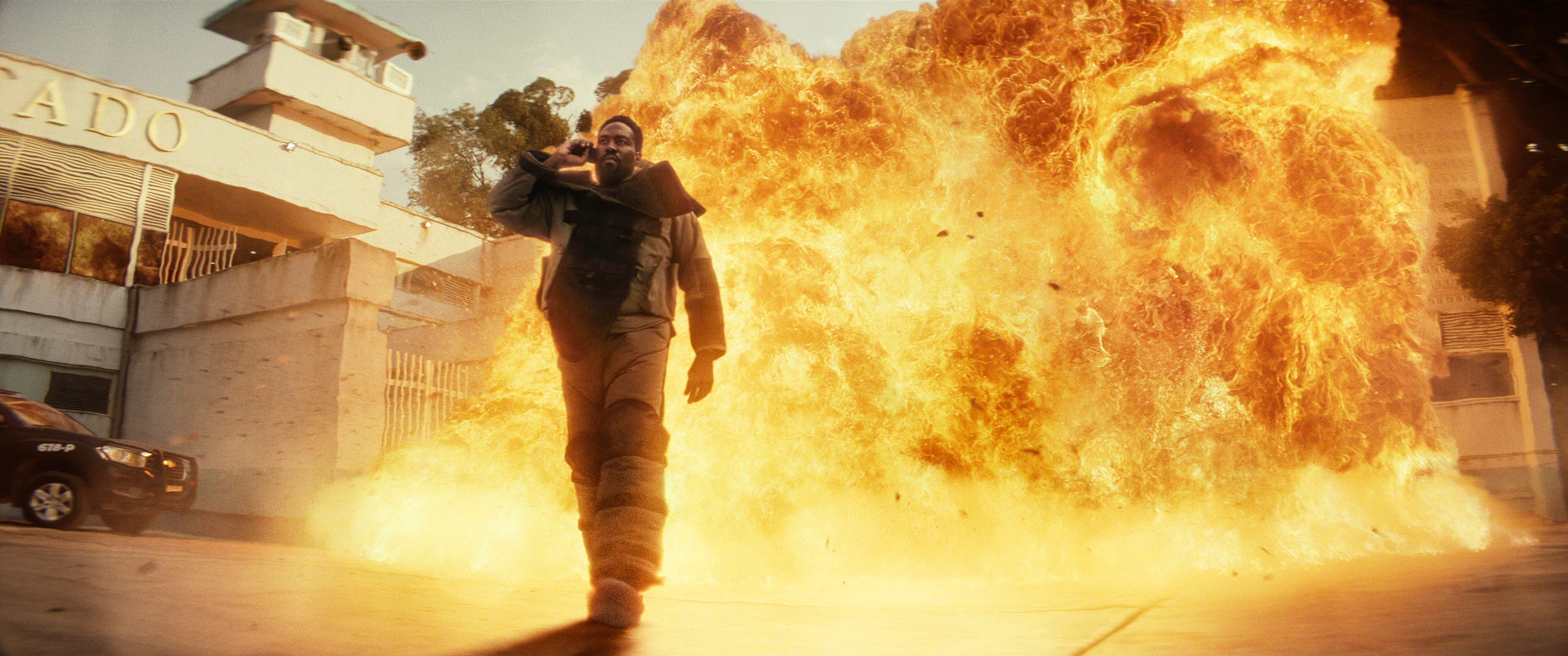
The only time we referenced anything is [because] they wanted an iconic Man on Fire scene. There’s a point in the 2004 film where Denzel [Washington] has got the police chief strapped to the hood of a car, and he’s inserted an IED into the dude and tries to get as much information out of him as he can. He tells the guy that he’s gonna die, and then he walks away, and it goes off. It’s basically two shots. There’s a wide scene, the explosion happens, and then there’s this really strong tight on Denzel’s face with the explosion in the background. They wanted to emulate that with Yahya, and we have something like that in the prison sequence where he throws this duffel bag full of C-4 [explosives], and then he presses the trigger and this explosion goes off. The director, Clare Kilner, filmed it with six cameras, and then edited it. We ended up with three shots—the wide and him blowing it up, then another angle low on the ground, him walking, and then we end on him tight walking out of frame. But otherwise there wasn’t really [any reference].
I’m a huge Tony Scott fan, and I loved Man on Fire when it came out, but this is its own story. You have the John Creasy character, you have this young girl, but the circumstances are completely different. But, I will say this: the marketing of it, I think, could have been done better. Because when the first trailer dropped, people thought, “They’re remaking the Denzel film.” I don’t think there was enough done to make people understand that no, this is the same character, but a totally new story. This is not a remake. We didn’t even use the word reboot to describe the series. It was just its own thing. So that was unfortunate, at least for me, when I was reading some of the comments in YouTube and stuff like that.
Who would you say are some of your influences?
[H.R.] Giger was a big influence. I was mesmerized by the OG Godzilla. Hideo Kojima, I love his works—Death Stranding, what he did with the Metal Gear Solid series. I love action films. John Woo was a huge influence of mine. When I got to work with him, that was amazing. I worked on Broken Arrow first, did some stuff for Face/Off, but then ended up visual effects supervising Windtalkers for him. Tony Scott was big. Ridley, as well, obviously, because of Alien and everything he’s done. And working with Tony on Spy Game, even though we only did like 20 shots for the film, was great.
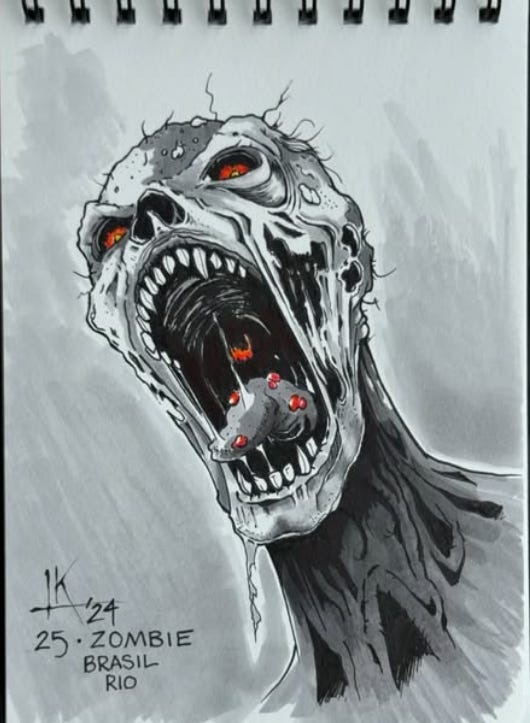
And then beyond that, when I see any kind of artwork... I think that’s been the one good thing about social media is that people have been able to get their art out there, so it inspires me. I keep telling myself I gotta keep drawing, but I have this block where I can clearly see the final product in my head, but when I translate it to paper, it’s [not the same], so I get frustrated. The one thing I’ve been doing religiously is Inktober, so every year I will do 31 drawings, and I keep hoping that jumpstarts me into keeping up with it.
I have a lot [of inspirations]. Anime—when I saw Akira in the theaters, oh man. I’ll never forget that. Right now I’m finding a lot of inspiration from video games. The storytellers nowadays in video games are amazing. I just played the game Mixtape, and that was amazing. It’s this very simple concept. The game was only like three-and-a-half hours, but it’s a pure joy because it was all structured around music. The guy who did it curated all these songs that fit perfectly in each sequence of the game. I was blown away.
I like horror, because I find that horror is a very creative genre, more so than any other. Comedy is hard; dramas are more straightforward. But with horror, there’s almost no limit to what you can do. I find that exciting. I’m a big fan of The Descent. That’s a fantastic film, and the creature design in that, the simplicity of it, is great. I have so many different things I watch and hopefully learn from and am inspired by.
What advice would you give to someone who wants to follow in your footsteps?
When I went to Digital Domain Vancouver, we were doing Jack the Giant Slayer, a Bryan Singer film. The talent pool up there was pretty shallow because at that time DD was one of the first big AAA studios to have a facility there. No one else had joined yet. There’s Vancouver Film School up there, so we would get kids graduating from there and we would hire them. But one of the frustrating things I found is that quite a few of the kids didn’t want to invest the time to learn the processes. They were like, “I want to be a composite supervisor. I want to be a visual effects supervisor.” It doesn’t work like that. One big negative of Covid was that studios and streamers pivoted and were like, “We’re getting as much content out as we can.” There was a shortage of people, and people ended up getting promoted into positions they were not ready for. Unfortunately, that course has not been corrected.
The other downside is because so many facilities now are work-from-home, these junior and mid-level artists don’t have that ability to turn to a senior artist next to them and be like, “Hey, can you take a look at this and tell me what I’m doing wrong or how I could improve this?” That’s gone. You have to wait until a review where you get on a Zoom call, and you’re looking at it that way. So, these poor kids aren’t getting experience handed down to them the way that they should.
A lot of people will tell you for this industry it is important to understand the fundamentals of photography, understand color theory. Roto is a discipline that I have mad respect for, because I’ve asked people to do precise roto of things like a person with flyaways and crazy hair—that’s an art unto itself. A lot of people are, “Oh, AI can do that.” No. It can get the base structure. When you’re talking about really fine details, that takes an artist. Learning those disciplines and understanding them are important, so as you move up through the ranks, you’ve understood the whole process. You don’t necessarily need to learn how to animate, but it’s important to understand what each department does in order to finish a shot. It makes everybody’s jobs easier. So, the more you can learn and absorb, the better.
I’m also a big fan of people who are interested in the work. I tend to go after specific things. I have a list of 10 shows or films that I’m actively pursuing, and they’re in stages of various development points. I’m always excited when I work with people who are excited to be on the project that I’m on. Because if you’re just doing it as a nine-to-five job, you might as well go do something else. You have to have passion to do this job, especially with all the craziness going around and all the uncertainties.
I love doing what I’m doing. I would talk to anybody trying to get into the industry to explain the kind of things that I’ve said. I wouldn’t talk anybody out of it, because if this is something you want to do, more power to you. I’m all for it. It’s just unfortunate that I would have more caveats and more discretion to impart, because the industry has changed so much over these last five years.
To learn more about Kevin Lingenfelser, find him on Instagram.
This interview has been edited for clarity and length.
You might also enjoy…

