

CR 093: Gemma Correll Takes Readers on a Trip to ‘Anxietyland’
The award-winning cartoonist, writer, and illustrator discusses her new graphic novel, and why laughter is sometimes the best medicine.

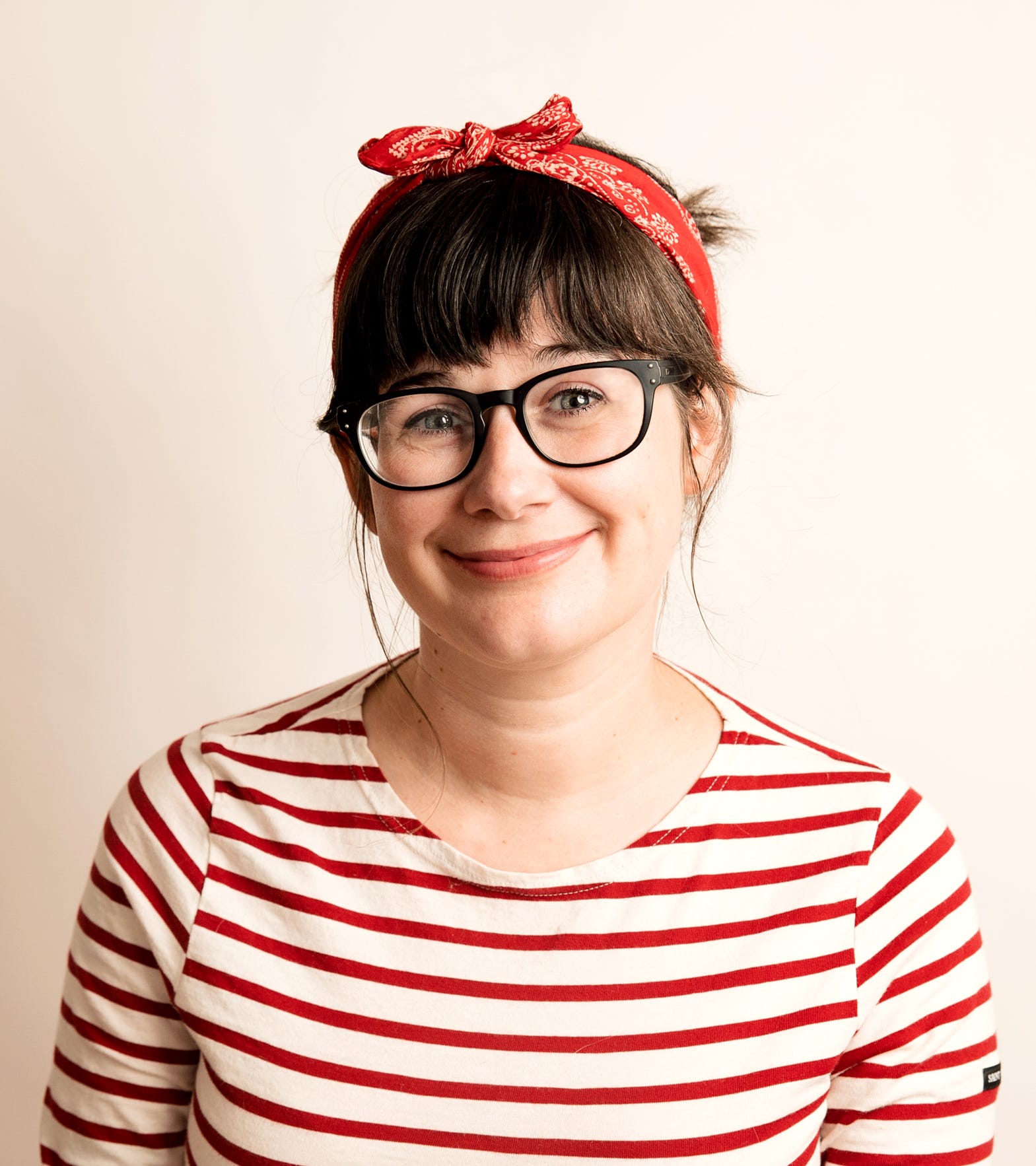
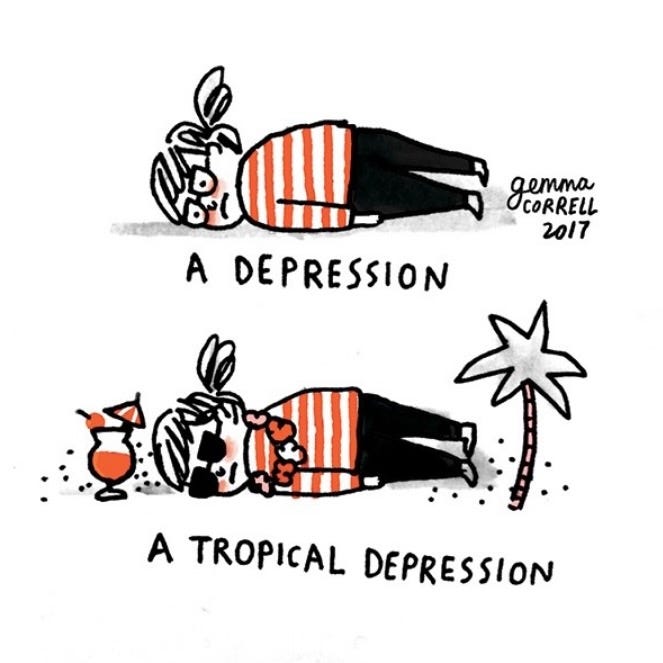
Anyone who has lived with depression or anxiety knows they are no laughing matter. And yet, sometimes the best way to get through it is to find the humor in the situation. That’s precisely what Gemma Correll has done in her new graphic novel, Anxietyland. Featuring her signature black, white, and red illustrations and witty self-deprecation, the book brings readers along on a challenging, darkly funny journey as Correll delves into her lifelong struggle with mental illness. Comparing the experience to that of a theme park she’s dubbed Anxietyland, she depicts her ups and downs as attractions—among them, the Loop of Anxious Avoidance, Hangxiety Falls, and the Worry-Go-Round.
The book is, at times, heartbreaking, but ultimately, hope prevails. It is a story Correll’s many fans—she has nearly a million followers on Instagram alone—will undoubtedly be thrilled to read. But as she embarks on her book tour, she makes it clear that it’s absolutely fine if some of her readers don’t make it out to see her.
“A book tour is a big undertaking,” she says. “I am very careful to plan my time effectively and not take too much on. But at the same time, I totally understand that not everybody feels comfortable in those kinds of situations. So I would love to meet people, but I also get that not everybody is into it.”
Over a recent Zoom call, Correll spoke with me about her influences, the importance of taking breaks from social media, and how the U.K. and U.S. differ in their approach to mental health.
This content contains affiliate links. I am an affiliate of Bookshop.org and I will earn a commission if you click through and make a purchase.
SANDRA EBEJER: Congratulations on the book! It’s fantastic. I know you worked on this for a long time. How does it feel now that it’s finally being shared with the world?
GEMMA CORRELL: It’s pretty crazy. It’s very strange to see it as a real object that I can hold. I mean, it was in my head for a long time before I even started seriously working on it. And then it was four years of sketching and sticking stuff up on the walls to try and figure everything out, so it’s a little surreal that it’s actually a real thing now.
When did you develop a love for illustration and cartooning? Did you grow up in an arts-loving household?
Not particularly, no. We were just an average family. My dad is a good artist, but not professionally or anything, just kind of amateur. My parents had a lot of cartoon annuals, so I grew up reading those. There was a cartoonist who lived in the town that I grew up in, Ipswich. His name was Carl Giles, and he used to do cartoons for the newspaper. They would make annuals, and we would get those every year. I was obsessed with those. And also The Far Side by Gary Larson. I was surrounded by books. I grew up reading a lot, just loving books and children’s books and illustration, and I was encouraged by teachers at school a lot, as well, partly because I was always drawing in the margins of my books. They started giving me my own sketchbooks to draw in. Like, “Please stop drawing in your textbooks.” [Laughs]
Anxietyland is your first long-form book. How was it to jump from shorter works to something of this magnitude, especially given the personal nature of the book?
It was quite challenging. As you said, I’m used to doing short form, which doesn’t take a whole lot of planning. Everything I do starts in my sketchbook. I can figure out a single panel or six-panel comic just in my sketchbook, and then it’s straight onto the page. But with this, I needed to have some kind of structure. I needed to plan a lot more, and that is not my strong suit. This was completely new to me, so I went through a few different ways of approaching it.
Creative Reverberations is a reader-supported publication. Each interview takes many hours of work. To read all posts and support ad-free, independent journalism, please become a paid subscriber.
I tried to write everything out. I sat with my laptop and typed everything, which didn’t really work. Drawing and writing have always been so intertwined for me that I can’t separate them, which meant essentially having to write and draw every page out, including planning the whole composition of every single spread and literally drawing them all out on printer paper, sticking them up on the wall, and literally moving stuff around and cutting stuff out and redrawing pages until I had them how I wanted them.
How did you come up with the idea to portray these issues as a theme park?
I like putting more complicated subjects in a cartoony format. I love infographics, and I love trying to make things a little more interesting to read while putting them in a different framework. I just love theme parks, and I’ve always been looking for an excuse to use one as a framework for something. And I always have thought of anxiety as like a roller coaster. It’s a little cliché, the emotional roller coaster idea, but that is really what it’s like. There’s so many ups and downs and loops going round and round. I just thought it would be a fun way to use a bit of humor and levity to portray something that’s quite serious. And also, I wanted to business expense my trips to Disneyland.

Smart! There are parts of the book that are very funny, but there are also moments that are quite sad. Was it difficult to find a balance of keeping it lighthearted for readers, but serious enough to not poke fun of what you were going through?
Yeah, I was very conscious of getting that balance right. I wanted to be as honest as possible about things that happened to me. I didn’t want to leave anything out, as long as it was personal to me and not somebody else’s story. I think I naturally have always used a certain amount of humor, and I wanted to keep that same amount of balance between serious and humor that I always have, while also telling this longer narrative.
Were any topics off limits?
The things that were off limits were things that happened [to others]. I talk about my time in an outpatient program in hospital, and there were certain things that might have happened to me there that involved other people, so I was very careful about leaving that stuff out. And also, any kind of family-related stuff. I was conscious about [the fact that] my family are going to read this book. A lot of this stuff is new to them. It’s new to, in fact, almost everybody who knows me. So again, just making sure I’m telling my side of the story and not trying to tell someone else’s story.
One of the things you address in the book is that British and American cultures are very different when it comes to addressing mental health. You grew up in the U.K., but you now live in California. How did the move impact your approach to treating your anxiety and depression?
I think that while I was in the U.K., I really didn’t have any idea of what therapy was or what it entailed. It just wasn’t something that was talked about in my family or with anybody, really. I tried out a few different types of therapy blindly, kind of flailing around trying to find something that might help, but I didn’t really know what kind of help I needed, what I was looking for, who would even provide this kind of help. I grew up not going to the doctor very often. And in my mind, the doctor was someone you went to for a broken leg or whatever. It never even occurred to me that you would go about a psychological issue.
But I’d also grown up seeing America was like the land of therapy, just from consuming American media and TV shows. Everyone was always going to therapy. And it still wasn’t totally clear in my mind what that meant, because it’s always depicted as a shrink on a couch, and you’re lying on a couch, just talking and talking. I wasn’t sure if that’s what I wanted or what I needed. So it really took me being forced into therapy, basically by ending up in hospital, to discover that there were different kinds of therapy and things that were specific to what I needed. And those things are available in the U.K.; I just didn’t know it at the time. They’re also free, so it would have been nice to know.
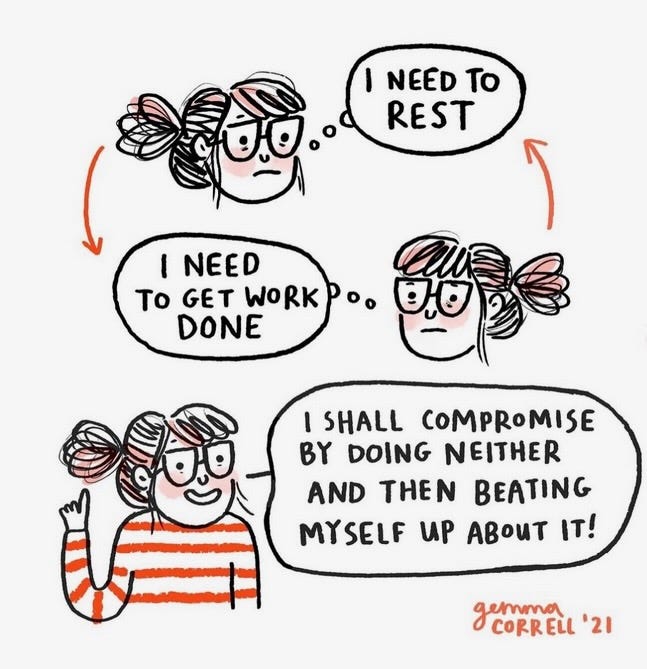
Social media can be challenging, especially for anyone who deals with mental health issues, but that is really where you began to build a following for your work. How do you ensure that that space remains a positive one and that you don’t get sucked into doomscrolling or negativity?
Yeah, I feel like it’s becoming more and more difficult. I don’t want to complain about the algorithms, but with the algorithms, it’s become a lot less fun of a place to be than it was starting out. So I’m pretty strict myself. Now if I’m going to post something, I will post and then I will put my phone in the other room and leave it there, because it is so easy to get sucked into the doomscrolling. Even if you have the best intentions and everyone you follow is a positive person and artists that you love, you still get all the adverts and things that you have no choice over. There’s no chronological feed anymore, so you’re just being fed whatever the algorithm wants you to see. It’s not healthy. But there has to be some sort of middle ground between being completely off social media and also needing social media to promote yourself. And it’s supposed to be fun! I still enjoy it when I actually get to see the things that I want to be looking at—dog pictures, mainly.
Are you ever surprised by the things that resonate with your readers?
Less so now, because I’ve been lucky enough to be able to interact with so many people, either online or in person at events. But when I started out, I really was surprised by the things that resonated. Mental illness can make you feel very alone, like you’re the only person in the world who feels that way. There were things that I would share, and I’d think, “Nobody is going to get this. People are going to think I’m weird.” And then those are the things that actually resonated the most with people. And yeah, it’s very gratifying. Obviously, it’s not nice to see other people suffer, and you don’t want anyone else to feel this awful way, but at the same time, having that sense of community is nice. I think that’s also been lost now with the way that social media is going.
You recently shared your sketchbooks in an Instagram reel. Do you draw all the time, even when not on deadline?
Yes. Yeah, I have to. I’ve heard people say that drawing is like a muscle, and I agree with that. It’s something that you have to exercise constantly. I have sketchbooks all over the house. I say sketchbooks—sometimes it’s just pieces of loose paper that I’ll eventually try and bind together or something to make a book. But, yeah, it’s completely essential to my practice. If I’m trying to think of an idea on the spot, my mind will just go blank. I need to be able to go and look back through old sketchbooks and find something that will spark an idea.
Who are your influences?
I think my biggest influence is Linda Barry, the cartoonist. I love her work, and I love the way that she is so her own. She is so popular, and yet she’s doing her own thing and just not kowtowing to any trends. Everything she does is just really original. She also works at a university as a professor, and she’s always trying new things. The students she works with are not necessarily traditional art students. They come from all different areas. So it’s really inspiring to see how she excites people about art and about making comics and cartoons. Because you can easily get sucked into—again, sorry to keep talking about social media and the algorithm—these trends that come up a lot. It’s very easy to get sucked into how you think you should be working, and then you see someone like Linda Barry or other people that I love—Roz Chast I’m a massive fan of, Tom Gauld—who are really doing their own thing. They have their unique voice. I just love their work.
Is there anything that you haven’t done yet in your career that you’re really hoping to do someday?
I’ve worked a little bit in animation—I did character designs for a PBS Kids show called City Island a couple of years ago—but I would like to explore that more. I would like to use my own characters in animation somehow. I, personally, do not have the skills to make that happen. I can draw, but I can’t make things move. That’s a whole different clever brain process that I don’t have access to. But that’s something that I definitely want to explore more in the future.
Anxietyland starts with you in the midst of a weeklong anxiety attack, and the advice you receive from pretty much everyone is, frankly, useless. Do you have any advice for people on how to respond when someone reaches out and shares that they’re going through a difficult time? Because clearly the advice shouldn’t be to “drink some tea.”
I can’t speak for everyone, but personally, all I need to know is that somebody is there for me. I don’t really want advice because I already know what I need to do. And if I want to drink a cup of tea, I will drink a cup of tea. I just need to know that person is there. I don’t necessarily need them to call someone for me, but if they have any resources they can share with me, that’s always good, particularly if they’re someone who’s experienced a mental health crisis themselves. But yeah, just being there is really enough for me.
To learn more about Gemma Correll, find her on Instagram.
To purchase Anxietyland, click here.
This interview has been edited for clarity and length.
You might also enjoy…


Wonderful interview with so many cool insights. I enjoyed hearing some of the behind-the-scenes thoughts that went into the making of the book. Artists and creators are magickal.