

CR 089: Jenny Lawson Wants You to Know It’s Going to Be Okay
The New York Times bestselling author discusses her mental health struggles and her latest book, “How to Be Okay When Nothing Is Okay.”

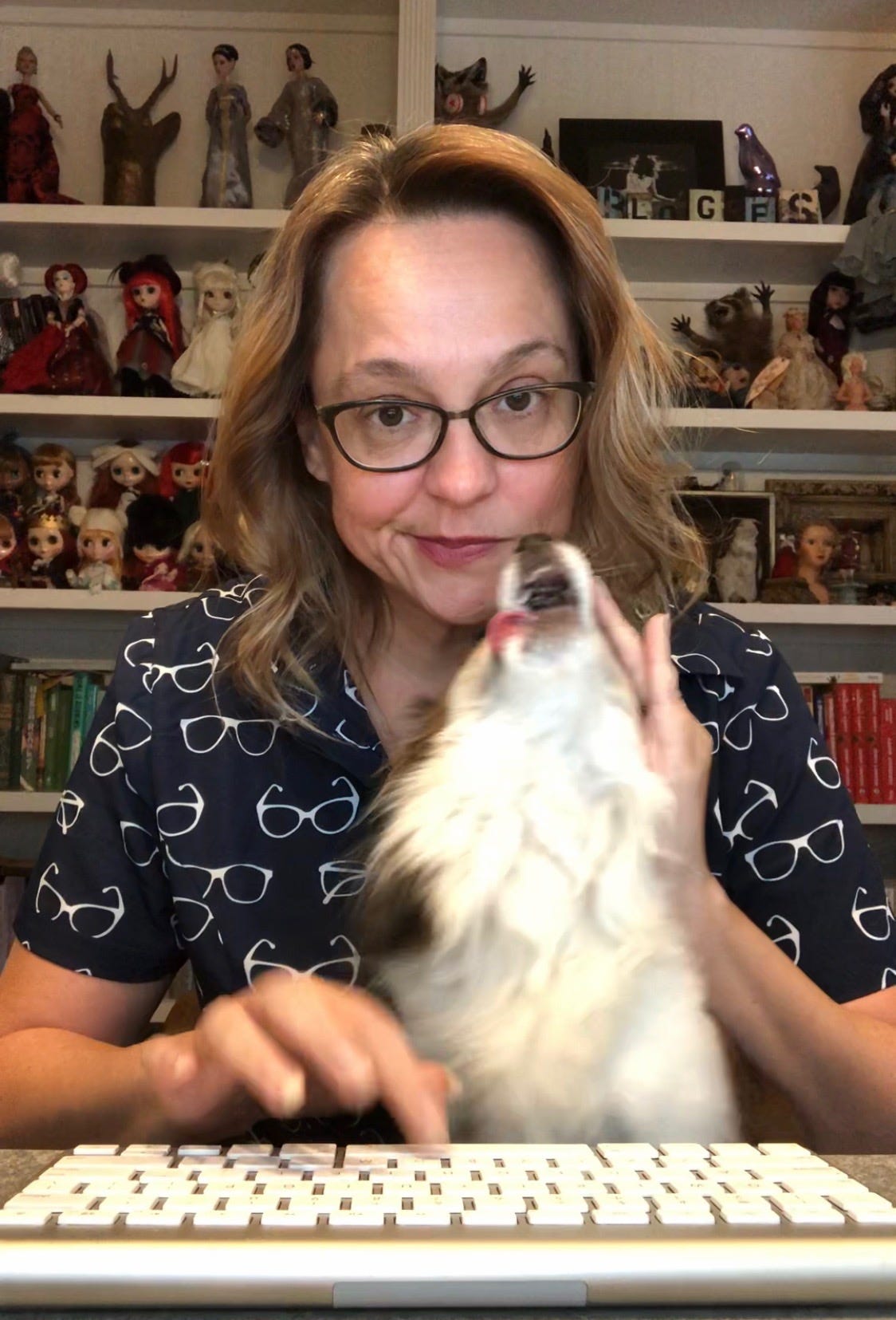
Anxiety, depression, and ADHD might not sound like topics to joke about, but fans of Jenny Lawson know that everything in her life is fair game. For more than 20 years, the author has used dark humor in her writing to address her struggles with mental health and chronic diseases. Her hugely popular website, The Bloggess, attracts tens of thousands of readers each month, while her first four books have been New York Times bestsellers.
Her latest book, How to Be Okay When Nothing Is Okay: Tips and Tricks That Kept Me Alive, Happy, and Creative in Spite of Myself, is part-memoir, part-self-help, and very funny. With chapter titles like “Let’s Kick Sadness Right in the Dick” and “Let’s Make It Easier and Give Ourselves a Fucking Break,” it’s exactly what longtime fans of Lawson have come to expect. Though she admits that she’s sometimes surprised that fans have stood by her for so long.
“I always worry that I’m going to share too much,” Lawson tells me. “And it will be the point when they say, ‘Oh, no, no. We were with you up until you got into the nitty-gritty of it.’ What I have found is that so often when I think I’m the only person who deals with dermatillomania or trichotillomania or something that is not a common sort of thing, a million people will come and say, ‘Me too! I thought it was just me,’ which is so wonderful.”
Over a recent Zoom call, Lawson discussed how the book came about, how reading saved her in her darkest times, and what she’s learned from owning Nowhere Bookshop, her indie bookstore located in San Antonio, Texas.
This content contains affiliate links. I am an affiliate of Bookshop.org and I will earn a commission if you click through and make a purchase.
SANDRA EBEJER: Congratulations on the new book! You’ve written extensively about your struggles with anxiety and depression. What made you decide to write a book focused on tips and tricks for others?
JENNY LAWSON: When [my kid], Hailey, went off to college, I fell into a really deep depression, because I felt very unmoored. One of the things I struggled with was the fact that they were leaving, and I felt like there was so much stuff I never taught them. There’s so much that I never sat down and said, “Learn from my mistakes.” And I thought, well, one of the ways I could feel more of a connection to them is if I put together a little collection of all of the tips and tricks I have learned in my time.
Technically, I’ve been working on this book for decades, because I am constantly writing in little notebooks things to remember and think about and reframe. So I was able to take these notebooks that are half-finished all around my office and start off with it, but the further I got, the more I thought, “Oh, but I left out this...” And finally, once it all started to come together, I was like, “You know what? I wish I had this book when I was younger. This would have been so helpful for me. Maybe other people will find it helpful.” And it was interesting, because I just recently got the finished copy and I handed one to Hailey, and I was like, “Look! I wrote this for you!” And Hailey was like, “I am really busy. I’m about to start pharmacy school. I’m taking all these classes. Can I read it when things slow down in a year or so?” [Laughs] I was like, “You absolutely can.” But yeah, that figures.
You’ve shared with readers that your anxiety began at a very young age. Were writing and books things you turned to as a kid in order to make sense of what you were experiencing?
Absolutely. My best friends when I was young were books and characters. I felt like I didn’t fit in when I was growing up, partially because I had a really severe anxiety disorder. And back in the ‘70s and ‘80s, that wasn’t anything that anybody talked about or knew about. My mom would say, “Oh, you just have a sensitive stomach. That’s what it is.” So reading was my way of finding people out there who I could relate to, even if they were imaginary. To me, they weren’t.
And writing was very helpful, not only to help get things out of my head that I needed to get out of my head for my own sake, but also because my shyness is so strong and my social anxiety is so strong that I have a really hard time talking to people unless it’s one on one, or I’m in a very safe place. So, I could write notes. I went to school in the ‘80s and ‘90s, and this was the golden age of note passing. It really felt like that was the way I could communicate with others and have friends, even though they weren’t friends that I would necessarily eat lunch with. I was too afraid, but I could still be a part of the group. Being able to pass those notes [allowed me to] still be a part of the community, even though I was a little removed from it.
Creative Reverberations is a reader-supported publication. Each interview takes many hours of work. To read all posts and support ad-free, independent journalism, please become a paid subscriber.
I read a recent interview you did where you said you had anxiety about doing press for this book about anxiety. And it’s interesting because you’re not a recluse; you engage with your readers and do press and you’re active on social media. Is it difficult to balance the necessary promotional aspects of your job with your mental health struggles?
It is hard, because I always get the idea that Future Jenny is going to have more energy than I actually do. And so it’s easy for me to say, “Oh, I can do this and I can do this.” And then it gets to the end of the day, and I realize that if I do three interviews in a row, the next day I will not be able to move.
So there’s been several things that have been really helpful. One is that I have figured out the most that I can possibly do and just ask for accommodations. I feel bad for publicity, because I have been asked to do a lot of really amazing things, and quite a few of them I have turned down because they’re either too energy focused or they’re maybe a little too scary. So I’m picky about what I do. Typically I will say, “I can only do two things a day before it starts to affect me mentally by the end of the day.” And my husband is always like, “Two things?? My God, how are you getting past this with two things?” But everybody has a different way of being, a different level of energy.
Also, it’s really helpful having medication that helps. In the past, I had a really hard time. I still sometimes struggle with finding that perfect spot, because I have ADHD, so I need to take my ADHD meds, but because they’re a stimulant, they can make an anxiety attack come on. But if I don’t take them, I’m definitely gonna have an anxiety attack because I’m not going to be able to concentrate, and I’m going to be completely rambling and not getting anything done. Actually, discovering beta blockers has been really helpful because they lower your heartbeat a little bit when you’re really scared. Like, let’s say you’re a violinist and you’re going to perform and your heart is pounding. If you take a beta blocker, it lowers it just a little bit. And if you don’t hear your heart pounding, you’re less likely to think, “I’m having a panic attack.” But it doesn’t make you tired or groggy in the same way that an anti-anxiety drug would when I need to be working. Finding that perfect balance is not easy.

Your writing is so funny, yet also vulnerable and open. You don’t shy away from the hard stuff. Is it a challenge to keep your writing lighthearted so that it’s not too dark, but also be honest when you maybe don’t feel very funny?
It is a very fine line. I used to be much more scared about it because I would think, “This is going to offend people.” There are a lot of people who do not understand dark humor or are not the kind of people who can find a way to laugh at a funeral. But what I have found is that who I’m writing for are the people who are going to get it. If I make a joke, it feels like all bets are off. You’re not going to offend me. You don’t have to be like, “Oh, this is so serious. Everything has to be serious, and you have to say this in a perfect way and do this in a perfect way.” It’s also a really good way to welcome in people who may not have ever gone through whatever that situation is, whether it’s miscarriages or depression or anxiety, where somebody would say, “This doesn’t have anything to do with me. Why would I read it?” But if you can get, right from the beginning, something to make you go, “Oh, that’s funny,” it invites you in.
What’s really wonderful is so often people will come to me and say, “I read this because I thought it was really funny. But after I read it, I realized I was really struggling with something and didn’t recognize it before.” Or “I read this because I thought it was humorous, and then I gave it to my kid to read, and they came to me and said, ‘I’m so glad you gave this to me. I’m actually dealing with something really hard, and this gave me a way to talk about it.’” So, yeah, if you’re the kind of person who can laugh at a funeral like my sister and I do every single time, then this is the kind of humor you will probably enjoy. If you go, “Oh no. Never. Can you ever laugh at a funeral?” then you might not love it.
Is anything off limits when it comes to your writing? Are there any subjects you don’t feel comfortable delving into publicly?
There are a few things. Anytime that I write about anyone, they get to see it first, and I’ll delete anything they say “I’m not comfortable with.” The other thing is, whenever I’m making fun of someone, I have to be the butt of the joke. I’ll make fun and find humor in a situation, but I try to do it in a very loving way, and I think that comes across. And my family generally is supportive of all of that.
There are some things I have not written about because I haven’t found a way to explore them in a way that I think is healthy yet. Before I met [my husband], Victor, I was in a really abusive relationship and every once in a while I think, “I need to write about that,” but I just have not. In spite of the fact that it was 30 years ago, I still have not found the right way to come about writing about it. A lot of the times when I’m writing, I want to be able to find an end, even if the end is just like, “And I’m still working on it,” but I don’t really have one for that yet. And honestly, it’s easier not to write about it, because it means I would have to go back and reprocess that and go, “That was a really hard time.” I don’t think there’s anything that is off limits for me to talk about, but there’s definitely some things that I don’t feel I’m ready yet to put in writing for the world.
Your bookstore, Nowhere Bookshop, is one of the few businesses that not only opened during the pandemic but has continued to thrive. And you write in the book that “it was painfully humbling to realize that loving bookstores did not automatically make me successful at running one.” What has owning the bookstore taught you about yourself?
We opened the week of lockdown, and I was like, “Well, that’s it. We’ve just lost everything.” But luckily, we had enough people who joined our book clubs that it allowed us to pay our rent. I mean, we went almost a year before we fully opened our doors, because we wanted to make sure it was really, really safe for people. Learning how to own a bookshop is so rewarding, but it is so challenging. It is so hard. The margins are thin and everybody’s competing with you—I mean big box everybody, not other independent bookshops. And I struggled a lot with the fact that I wanted to know everything all at once. But every time I would make a mistake, I would remind myself that if I’m making a mistake, it means I’m learning, and if I’m learning, that means I’m living. Because how incredibly boring would it be to say, “Well, I guess I’m done. I know everything now”? I’d be finished.
You and your writing are a light to so many who feel stuck in the dark, and you make us weirdos feel okay about being weird. Are there any authors or works of art that do that for you?
There are a lot. Samantha Irby, all of her work. Allie Brosh I think is incredible. I really love Shirley Jackson, because not only does she write the dark and the hard, but she also wrote funny parenting stuff. I love that she was very, “Here’s life, and it’s difficult, and I’m putting out this incredible stuff” that, at the time, was very controversial. When she was first putting out her stuff, I think a lot of people were like, “Are you kidding me with ‘The Lottery’? What is wrong with you? Get out of here.” But now you look back and go, “Oh my God, it was incredible.”
I follow so many artists, and of course, I can’t think of any of them at the moment. Katie Gamb is one of my favorites. She did the oracle cards for [my book] Broken, which I really loved. My house is actually filled with original art. Books and art are where all of my money goes to, and it is the weirdest art. It’s the kind of art you walk in and people either go, “Wow!” or they go, “What? I need to get out of here immediately. What is happening? Why is this so scary? What is going on?”
You’ve had so many achievements in your career. Is there anything you haven’t done yet that you’d like to attempt?
There are a lot of things in theory, but so many of those things, if they were actually offered to me, I probably would say no because they’re too overwhelming. The one thing I really would love to do—and I’m putting it out into the universe so that maybe one day it will happen, even though I can’t imagine that it will—is start writers’ workshops. I’ll get a castle in Scotland, and everybody comes for two weeks, and every night we come downstairs and we do a Mary Shelley kind of thing where everybody shares whatever they’re working on. If I had a billion dollars, I would drop everything and be like, “Let’s do that!” And everybody gets on a train, and we all go into our little train cars and we write, and then at night, we come out to the train booze car—Is there a booze car? Let’s say there is—and we all read or share our art. I love that idea. I get so inspired by being around other people who are creative, but I also get so drained by it. So the idea of, we’re working, but we’re working in our own little rooms, and then at night, we’ve got a couple of hours, and then we run away again—ah! A dream!
Aspiring authors often feel like they have to sound a certain way in order to be taken seriously. Your writing is full of run-on sentences and f bombs and self-deprecating humor and doesn’t sound like anyone else. Do you have advice for writers about finding their voice, even if their voice seems to be different from everything else out there?
Don’t be afraid to be weird. In fact, embrace that. The thing that you look at and go, “Oh, this might be the thing that makes people run away,” is something you should really explore. That being said, whatever you write lives forever. So you want to make sure that you are comfortable with it, that you can live with it. It’s like the child that is out there forever. And occasionally you’ll look back and go, “I don’t know what I was thinking. Why did I write this?” And other times, you’ll go, “I’m so proud of that, even though it was a slice of life that doesn’t reflect me anymore.”
The most important thing that you can do is to embrace the thing that makes you stand out in a weird way. If you shared your writing with a group of angsty teenagers, what they would make fun of, generally, is the thing that is going to make people feel seen and feel heard. A lot of times we go, “I shouldn’t write about this, because people won’t relate, or they’ll think it’s strange.” But the way I look at it, there’s maybe one in 10 people who could pick up my book and go, “Oh my God. I feel so seen. This is 100% me.” And the other nine out of 10 would pick it up and have various degrees of, “Oh, that’s interesting” to “This is not for me. How offensive.” But when it comes to putting a book out or your voice out, it is so much easier to find that one out of 10 and to realize that you don’t really care so much about getting those nine out of 10 in with you, because those are not people that you’re necessarily going to vibe with and you aren’t necessarily going to like.
Realizing that what you put out into the universe is what you’re going to bring back in can be very inspiring. Sometimes I want to write really angry things about the world or my life, or things aren’t going well, and I just want to tear it all down. And I will, but I’ll always find a way to have something uplifting or inspiring or hopeful at the end. Because I want to feel that way, and I want my readers to feel that way, and I also want to bring toward me the people who are honest about their challenges and are angry and are upset but are also looking at the good at the same time. Because those people are amazing to be with, and they’re the ones that share the best stories, and who come to me and say, “Here’s a tip that worked for me.” And really, that’s how we all get along, is by being as honest as we possibly can and giving each other those little tools of how we can make the world better for ourselves and for others.
To learn more about Jenny Lawson, visit her website.
To purchase How to Be Okay When Nothing Is Okay, click here.
This interview has been edited for clarity and length.
You might also enjoy…

