

CR 106: George Pelecanos on Writing Killer Crime Stories
The bestselling author discusses his work on “The Wire” and “The Deuce,” and his latest novel, “The Blue Flame.”

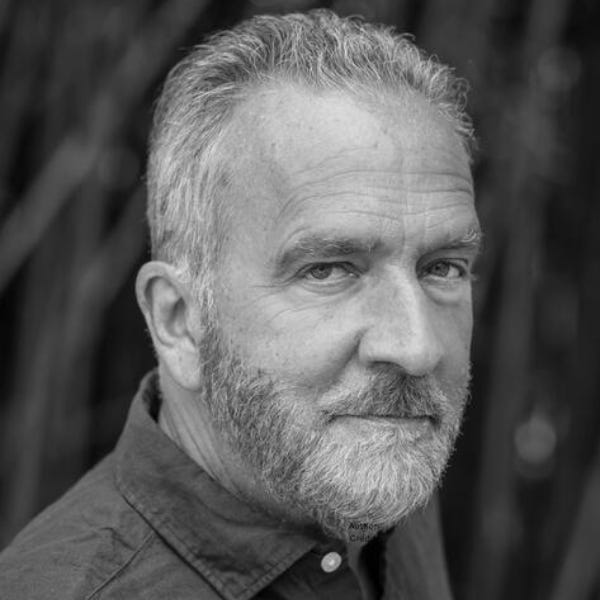
Few authors write as authentically about crime as George Pelecanos. A lifelong D.C. resident, he has spent more than 30 years writing fictional stories set in his hometown, often embedding himself into communities and conducting first-person research in order to create rich, complicated characters. The result is a body of work in which neither side, cops nor criminals, is truly innocent and no societal issue is as simple as it seems.
His books—more than 20 novels and short story collections so far—have earned him numerous awards and accolades, including a nod from Stephen King, who referred to Pelecanos as “perhaps the greatest living American crime writer.” In television, he served as a writer on the highly acclaimed productions The Wire and Treme, and with David Simon co-created two HBO series, The Deuce and We Own This City.
The common thread for these many projects is the honest portrayal of urban life, from racial tension and crime to the mundanities of police work. In fact, Pelecanos says he has no interest in telling stories in which car chases and gun fights lead to a neat and tidy resolution.
“It bothers me when I read or see a TV show with homicide detectives pulling their guns and getting into shootouts just because they need an explosion every 15 minutes,” he says. “It doesn’t happen. Most homicide cops never pull their guns in their entire career. Why would they? The crime’s already been committed.”
Pelecanos’s latest novel features the return of D.C. private investigator Derek Strange, a character he’s written about for 25 years. The sixth book in the Strange series, The Blue Flame finds the P.I. older and somewhat slower, but still intent on solving crimes. Over a recent Zoom call, Pelecanos discussed the book, his writing process, his advice to aspiring novelists, and his return to Strange, possibly for the final time.
This content contains affiliate links. I am an affiliate of Bookshop.org and I will earn a commission if you click through and make a purchase.
SANDRA EBEJER: If I’m not mistaken, this is the first time you’ve written about Derek Strange since What It Was in 2012. What made you decide to revisit him?
GEORGE PELECANOS: Well, I always wait till it sort of knocks on my door. I don’t really have a plan. I was just ready to do it. I had an idea, and I had come off a television project I was writing, which involved the homicide division in D.C. I spent a lot of time with them, and then it fell apart, as those things often do. I had all this information and, you know, every crime writer would love to get embedded with the police for a while, especially homicide. It was a bitch to get in there. I had to jump through a lot of legal hoops and talk to the mayor’s office and all that stuff, so I didn’t want to let it go. I figured that would be a good time to incorporate [what I’d learned].
A lot of the novel takes place with this homicide lieutenant. You see the procedural aspect of it, and how it joins up with Strange, but also to resolve some things in his life. He’s lost his wife, and he reaches out to a woman that we first met when she was 12 in D.C. when they’re standing on the corner in Georgia Avenue and Otis Place, and it’s the first love of his life and he reconnects with her.
There is a sense in reading this that Strange is acutely aware of his age. Do you think we’ll see him again at some point?
I don’t know. My intention from the beginning was to write about his life from beginning to end. I don’t think I want to do the death of Strange. I leave him in a pretty good place here. But also, in a realistic way, he makes a lot of mistakes in this book because he’s old. It’s probably time to leave him.
One of the things you’ve said in past interviews is that you tend to write anti-detective novels in which things don’t wrap up perfectly at the end. That’s evident in your work in television, as well. What is it about that more realistic, sometimes slower paced approach that you’re drawn to so much?
Well, the big lie of the mystery novel or the crime novel is that when a murder gets solved, the world is put upright again. It’s a comfort to the reader and so on, and it’s just not true. When there’s a violent death, the ripples in the pond emanate out into the community. You can’t put the genie back in the bottle. It can never be really solved. You can’t solve a murder unless you can raise somebody from the dead. And you always remind the readers of that. By the end of the book, the sense you get is the tragedy of violent death.

What is your writing process? Are you a plotter or do you just dive in?
I have a situation and then I just start writing. It sounds like it’s writer talking bullshit, but the characters end up writing the book. Once you’ve discovered the characters, then it all makes sense and the book gets written for you. But I don’t plot; I don’t outline. There’s a point in the book where I will write down what needs to happen next, just to remind myself. But that’s about it.
I’ve talked to a few authors who have done series like yours where they visit characters over time, and they say it gets more difficult as they get older to remember everything that happened in the previous books. Do you find that’s true for you?
Yeah. I have to go back and reread, make sure I don’t make a major mistake, and I have. And that’s what copyeditors do. They catch you. But yeah, there’s cognitive dissonance as you get older and you forget things, especially things in the near past. My memory of my teenage years is sharper than it is for 10 years ago.
I read that you went to film school as an undergrad, and it’s clear from reading The Blue Flame that you have a love of movies. There are quite a few film references in there. When did you decide you wanted to be an author? Did you write growing up as a kid?
No. I wanted to be a filmmaker first. I had a big love of movies growing up, and I was fortunate to grow up in the ‘70s when it was the golden age of film. So I was watching good films, but not just the ones everybody talks about. I was also a big fan of exploitation and blaxploitation film. And living here [in D.C.], it’s easy to go all over the city. I would just seek out these movies.
So what happened was, I went to the University of Maryland, and I majored in film and found my tribe there. It was a bunch of young people during the punk and new wave explosion, and it was all coming together for us. But I took an elective class in crime fiction from a professor named Charles Mish. I thought it would be an easy class to pass because the syllabus said, “Read books and discuss them.” This guy turned me on to crime fiction, and the thing that got me jacked up was it was about people I knew—by that I don’t mean criminals, but it’s the one genre of fiction that’s really about working-class people. I always wondered about that growing up here and working in my dad’s diner.
My dad’s Greek, and he had a diner. When I was 11, my parents said to me, “Go up to the corner and get on the bus and go downtown and work for your dad,” and I did. That summer was right after the riots of ‘68, and I’m going down Georgia Avenue in a D.C. transit bus, and everything’s burned down. And yet, people on the bus, mostly Black Washingtonians, were standing straighter than I had seen them before. So then I get to work, and it’s my dad and I, and his Black employees on one side of the counter, and on the other side of the counter, because it’s 1968, is white people wearing ties. That counter meant something to me. Although I didn’t understand it intellectually, it was a border. And I was really interested in those people on the bus and what had happened. It’s what I write about to this day, that counter. It’s what I’ve always written about. So that was the fodder for me becoming a writer, but getting turned onto books in this elective class in my senior year is what pulled the trigger for me.
Creative Reverberations is a reader-supported publication. Each interview takes many hours of work. To read all posts and support ad-free, independent journalism, please become a paid subscriber.
Do you write every day?
When I’m writing a book, I write seven days a week and I try to write something every day.
Who are some of the artists or authors that influence your work or inspire you?
Again, it was really filmmakers in the beginning. It was Sergio Leone, [Sam] Peckinpah, John Sturges, Robert Aldrich. That’s what gave me my storytelling structure. And then [with] the crime novels, although I loved [Raymond] Chandler and [Samuel Dashiell] Hammett and all that, it was John D. MacDonald, Elmore Leonard, James Crumley—people that were more contemporary. I don’t read a lot of crime fiction now. I try to read a couple books a week, but it’s usually a variety of things that is just quality writing. It can be anything that’s good right now. I like Rachel Kushner a lot. I think she’s a fantastic writer. She’s probably my favorite current writer.
You had published a few books before you began writing on The Wire. How was the transition from writing novels to writing television?
I had written a couple scripts that were uncredited, but I did some cleanup work on scripts that became movies. So I knew how to write a script. What I didn’t know or anticipate was what it would be like in a writer’s room where people are critiquing your work. It can be pretty brutal. I never went to writing school, so I never had that, where I was sitting in a room and people were talking about what you’d written. That was one thing you have to get used to. And The Wire was a pretty brutal writer’s room. It was contentious at times. People were very direct, and all of us thought we were the best writer in the room, which is kind of a good thing. I’m in there with David Simon, Richard Price, Dennis Lehane. Good writers. But we’re very competitive, and we all wanted to kick each other’s ass, basically. And it made all the boats rise, I think. I mean, one of the reasons the show is considered to be a very good show is because out of that argument and out of our egos came some good stuff.
Did writing for TV change the way you approached your novels? Did you learn anything from the experience of being in that writer’s room that you took to writing your books?
Screenwriting, as you know, is all action and dialogue. So it’s actually harder than it seems because you’re trying to convey something without the crutch of going into the characters’ minds and backstory and that sort of thing. You can’t escape that way. You have to make it work through action and dialogue, only what you can see on the screen. So that did discipline me in my fiction writing. It made the fiction writing more lean and to the point, and I think it improved me as a writer.
Anyone who knows me knows that The Wire is my favorite TV show of all time. And my second favorite show is probably The Deuce. They’re both brilliant and so unlike anything else that’s out there. When you were working on The Wire or when you and David Simon were pitching The Deuce to HBO, did you feel as though people at the network understood what you were trying to do?
In The Wire, I wasn’t the showrunner, so I wasn’t privy to a lot of the conversations that David had with HBO, but from season three on, he had to basically beg HBO to keep us on the air. And he’s a really good salesman, so he did it, even though our ratings were not very good. When David pitched me on The Wire—when he said, “I’d like you to write for me”—he said, “It’s a show about cops and drug dealers.” That’s what he told me. He didn’t say, “This is the story of America” or anything like that. He didn’t blow it up or overinflate it. And that was the right thing to do because I found out what it was once I started working on it. With The Deuce, we told HBO it’s about the birth of pornography in New York City. And, of course, you like the show. You know it’s about a lot more than that. You know it’s also about the co-opting of women and the history of New York in those 10 years. It was very ambitious, but we didn’t tell them that. We just did it and surprised them, I think is the best way to put it. [Laughs]
One of the things that makes both shows compelling, as you were just referring to, is the layers. For example, with The Wire—yeah, it’s about cops and gangs and drugs, but it’s also about layers of society that feed into one another to enable these things to exist. It’s like a knot that can never be untangled of all of the things that have to come together to make these issues happen. Was it ever a challenge for you as a writer to make a cohesive story out of all of these topics—the government, the schools, the gangs, the drugs, the cops, et cetera?
You do it inch by inch. I mean, you’re in the room every day and you’re pushing the rock up the hill. I fought David when he wanted to bring politics in season three. I fought him on it. I mean, the very first political scene in the show is two people sitting in a diner, and they both want something. They talk around it, but they both want something, and they eventually get a compromise, right? I said, “Well, that’s it. What more can you say about politics?” I grew up in Washington, so I’ve always been disinterested in what’s going on down there. But he was right and I told him he was right once I got a look at what we were doing, because by bringing the politics into the show, it rounded out the whole story, and it really made it work.
The kids in season four, the reason that’s so affecting is it shows the whole overarching thing that I’m proud of about that show—we show people how things actually work in a city. I’d heard all my life about kids in the city. It was coded language, but it was always like, “Why can’t those kids just work hard and get out of the ghetto?” And we showed you why. There’s a ton of things weighing them down and against them, and we were really successful in disproving that particular lie. And the politics and the journalism in season five gave this panoramic view of how a city works and how people are broken down by systems.
You are a lifelong resident of D.C., and your books are all based there. There have been a lot of changes to the city since our current president was sworn in. How are things there now for the residents who have been there for decades? Does what happens with the administration change things for you significantly?
Absolutely. In my neighborhood alone, there’s civil servants who have lost their jobs and their living. These are people that could have done other things in life, probably made more money. A lot of them are attorneys that went to work for the government. They did it because they wanted to affect change, and now they’re paying a price for it. And the city itself has a different tone to it right now. A lot of people don’t even want to go into the city because it’s being policed. There’s a feeling of [being] under occupation. And of course, the big lie is that it was necessary. I can tell you statistics because I’m a crime novelist. Back in the late ‘80s, early ‘90s, there was almost 500 homicides a year. Now it’s less than half of that. This is not a dangerous place. It’s a city—there’s always going to be crime—but we didn’t need that. We didn’t need the occupying army to come in here.
You’ve been a professional writer for 35 years or so. There’s a lot of talk these days about the decrease in readership and AI taking over. How do you feel about the state of publishing? Do you feel like anything has changed? Have you noticed a difference as you’ve gone on in your career?
Well, I’ve had incredible highs and also valleys, so I’m used to it. I do think it’s harder. It’s harder to get noticed, and there’s virtually no reviewing in major newspapers anymore. The Washington Post closed its Book World. So people go to social media, but social media is problematic. I don’t want to get on social media every day and ask people to buy my books. It’s unseemly. I want the publisher to do that. And they do, but it’s hard to reach people. There’s some series now where the guy has six books on the New York Times bestseller list, and I don’t even know what [the series] is. I don’t see people reading those books. I sort of don’t understand the business anymore.
I’ve spoken to people who refer to you as a mentor. The Wire’s hair stylist, Janice Kinigopoulos, for example, said you’ve been a wonderful mentor to her kids. When you’re speaking with younger artists or authors, is there a piece of advice you find yourself giving frequently?
Focus on the work. Don’t get caught up so much in promoting yourself. I’ve been with [my agent] Sloan Harris since the beginning and we were both young guys. He was right out of the mail room, and now he’s over at CAA running things. He told me, “Just write. Don’t worry about it. Let me take care of everything.” I can tell you, honestly, I don’t know how many books I sell. I never have known. I don’t get on BookScan. What am I going to do? How am I going to change that, anyway? What matters to me is writing the best book I can and leaving something behind that has some worth to it. That’s the only thing I can do, and I’m really happy with my career, even though it’s gone up and down. But I’m still here. I’m still writing books, and it’s been a wonderful way to make a living.
Well, you’ve obviously done well as an author. You’ve produced and written multiple TV series. You directed a segment of a film, DC Noir. Is there anything professionally that you haven’t done yet that you’d like to attempt?
I’d like to direct a feature myself, and I’m working on that. That’s pretty much it. I’m never gonna retire. The plan is to continue writing books till the end.
To learn more about George Pelecanos, find him on Instagram.
To purchase The Blue Flame, click here.
This interview has been edited for clarity and length.
You might also enjoy…


If you appreciate this piece but cannot afford a paid subscription, another way to support my work is to buy me a tea. Thank you!