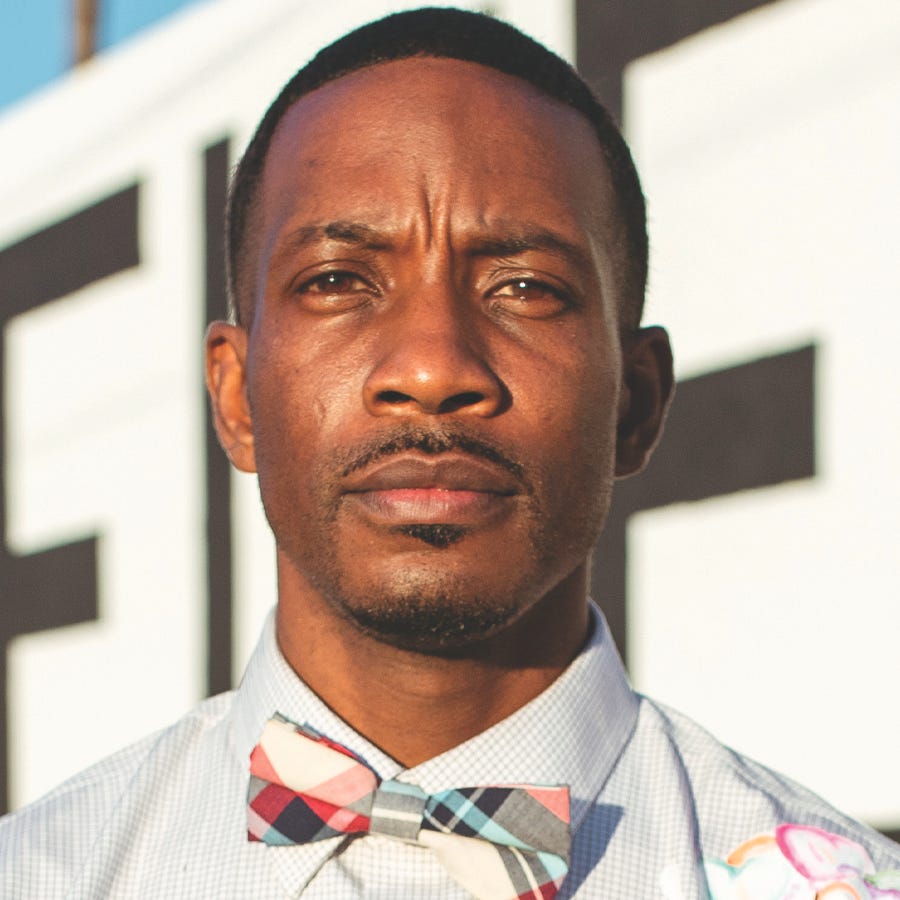
CR 091: Mike Norice on the Power of Art to Unite Communities
The acclaimed visual artist and subject of the documentary “Artfully United” discusses his life and career.
In the inspiring new documentary Artfully United, director Dave Benner and producer Chris Walters share the story of Mike Norice, a visual artist who is beautifying some of the most crime-ridden sections of Los Angeles one wall at a time. Norice, who built a following designing custom sneakers for star clients, including Elton John, Madonna, and Tom Cruise, began painting murals in 2017, with the hopes that inspirational messages and vibrant imagery would bring much-needed positivity to L.A.’s toughest neighborhoods.
Through a tour he calls Artfully United (which shares a name with his nonprofit), Norice set out to paint 20 murals featuring messages such as Forgiveness, Harmony, and Dream Big. Fifteen of the 20 have been completed so far, often thanks to community volunteers who assist with painting. The journey to complete the first 15 murals is portrayed in the film, which also profiles Norice’s childhood in Watts, where he was raised by a single mother while his father served time in prison. Now available on multiple streaming platforms, Artfully United is a stunning reminder of the power the arts have to transform communities.
I recently chatted with Norice about his background, the challenges of seeing his life portrayed onscreen, and the advice he gives to young budding artists.
Creative Reverberations is a reader-supported publication. Each interview takes many hours of work. To receive new posts and support my work, please consider a paid subscription.
SANDRA EBEJER: Inner-city neighborhoods are not typically a place where kids are exposed to public art. When did your love of the arts first take hold?
MIKE NORICE: I’ve been an artist pretty much all my life. I’ve been drawing since I was two. I didn’t understand what an artist was until I was in kindergarten, around five years old, when my teacher explained to me that I was an artist. Because I thought that the skill itself came naturally, like walking. I thought everyone can do it. It wasn’t until I was in that school setting that I knew I had an advantage over the other kids, and I asked my teacher, “Why don’t these kids know how to draw?” And she explained to me what an artist is. From then on, I started to understand what artists do and who they are and started building up who I am today.
You got a degree in fashion design and have had a really successful run in creating custom artwork on clothing and sneakers. How did that transition to the work you’re doing with Artfully United?
I’ve always been into fashion. I wanted to create a company that highlighted my art. And after doing custom clothing, custom shoes, whatnot, for 14 years, I discovered that fashion and art are very close to each other, but they don’t necessarily intertwine. I was not satisfied with the way my art career was being displayed within the fashion community, so I started to see what other options [exist where] I can highlight my own personal art career. So I started Artfully United in 2015 just to highlight my own art and do a mural.
With the Artfully United tour, you’re painting 20 murals in neighborhoods around Los Angeles. How do you go about finding locations? Are you invited to paint on specific walls?
In the beginning, I had to ask. Now it has basically taken over the city to where I turned down more walls than I accept. I’m down to the last five, and I try to better each wall each time. So if it’s not on a prominent street or it doesn’t get much exposure or it isn’t effective, in a sense, I won’t do it at this point. Some of the walls, people are inviting me. [They] say, “Hey, we want a mural on this wall.” But a lot of the good walls, I have to put a proposal together and talk to the owner or the manager of the building.
Was it difficult in the beginning to get that permission when you were first starting out?
Most definitely, yeah. Even the Forgiveness wall, the most popular wall, the owner didn’t want it up permanently. They only wanted it there temporarily. And then once we came back to paint it over after three months, because that was an agreement that he wanted us to do, his business increased so much that he said, “Let’s just leave it up.”
That’s amazing. What impact have the murals had on these communities?
It has definitely made a huge impact. It has created a sense of caring for the community and self-awareness because of these messages. You know, it’s not just art. When you pass by a street that says Believe or Hope or Forgiveness or Keep Smiling, it makes you think about something within yourself. The art is there, but it’s more about the message. It definitely reflects in a positive way to the community.
How long does each mural take? And when do you expect to be done with all 20?
Each mural, usually at this point, takes about three days. In the beginning, it was a lot longer because I was still learning how to do large-scale murals. But as far as the finishing up of 20, I’m not sure when, because who knows when that magical wall will hit? I’m not sure. I would like for it to be done soon, but I wouldn’t know. It took us almost nine years to do 15, so who knows how long it will take to do five because, like I said, I’m trying to get bigger and better each time.

One of the things you touch upon in the film is that there is a lot of gang activity in the neighborhoods where you’re doing these murals. How was it for you to navigate that, and to make sure you’re not only able to paint in these neighborhoods but do it safely?
I have my feet really deep in the streets. I attend a group called Ceasefire, where we meet every week, and we meet with a lot of gangs and do gang intervention. Plus, these are the areas that I lived in once upon a time. And gang culture and gang activity, it’s all about respect. That’s the first and foremost thing that you have to do, no matter what neighborhood you’re in. As long as you have that, they’ll give you respect, and then it’ll go good from there. They just want to be seen. You talk to one of them before you start the project, then most of the time, it’s all good.
At one point in the Artfully United film you paint a mural on a wall that is over 90 feet long and 23 feet high. When you’re painting something like that and you can only see a small amount of the painting directly in front of you, how do you ensure that the full painting is coming out the way you want it to?
Well, this is just to show how I’ve graduated throughout the years. In the beginning, I was just freehanding it. I would measure the wall, doing it the wrong way. But there are a lot of ways to scale your art. You could do a grid and scale it. Or you can do what is called a doodle grid, where you make a bunch of markers on a wall and you incorporate your artwork from an iPad. And then you have a projector; we can stand far away from the wall and project the image. And then there’s new technology that just started. I’ve done three murals with this technology. It’s Meta Quest virtual reality glasses, where you import the artwork into the glasses, and then you have the glasses show you where the markings are. That’s the easiest and most effective way to scale your art, and that’s what I currently use, but I’ve used every single technique.
That’s interesting. I’m curious what your thoughts are on AI. Obviously the technology is helping you in those ways, but there are a lot of kids who might think that the way to make art is to use AI. Do you have any thoughts or opinions on that?
I don’t use AI to generate my art. I use the technology to project my art and scale my art. You use it as a tool to assist, not necessarily to create. I know I can see the art that is created by AI. You can easily see there’s no soul and there’s no spirit within the art. So I use it for assistance, not dictation.
Have there been any artistic challenges with any of the murals you’ve done? Anything that was particularly hard to pull off?
Forgiveness, the first one. That was really tough in the beginning, and a lot of discouragements. In the beginning, you want to give up. I know I did. But I knew that this was something that will be big, and the city needs it, so I just kept pushing. But it’s never really easy. Even at this point, it’s still tough, because you have a lot of management and different ways of going about things. And I’m my biggest critic because I always like to do things bigger and better and constantly evolve my art. So in that sense, it’s hard on me. From the outside looking in, you would think that it’s easy, but it’s always hard on me because I’m always trying to better myself.

For the record, none of it looks easy! Your work is literally changing neighborhoods. What has Artfully United, both your nonprofit and the mural tour, taught you about the power of art and creativity?
It’s a conversation with the community. It’s taught me that I can relay a message, what I’m thinking, to everyone that passes by. And I’m glad that I’m doing a positive message, not a negative message. Some of these walls get up to 20,000 eyes on it a day. That’s power within advertisement. And I choose the positivity because we need to move forward in these communities and at least just have a positive mindset to your day to day. That’s why it’s designed that way.
How did the documentary come about?
Chris Walters was a client of mine from my store, and we started doing private commissions, me going out to Maine to do stuff for him and his household. He was right there at that fork in the road when I started to do murals. And him being a filmmaker, he said, “Let’s film this. Let’s document the process.” That’s pretty much how it came about in late 2014, early 2015.
The film not only discusses your work but paints a beautiful portrait of your family, including your dad, who was imprisoned for most of your young life. How was it for you, emotionally, to see your life up on the screen?
Yeah, it’s a very vulnerable piece. I’m very reserved. A lot of people, like friends I’ve known for years, didn’t know a lot of what was told in the documentary, because I just don’t go around talking about my personal business. But after seeing it, I knew that there’s other people that could be touched and moved by this, because they could be going through the same thing, and hopefully they could be inspired by this story. That made me feel good. I get a lot of positive responses by how they were touched—you know, their father was in prison, this is very encouraging—so I feel that it was good in that regard.
I always like to ask people about their influences or sources of inspiration. Are there any artists or works of art that inspire or influence your work?
I love Michelangelo. I started being taught as a fine artist, believe it or not, when I was 12. I started getting into oils and portraits and stuff like that. I studied him. I love Banksy. I started really getting into him in my early 20s. He definitely influenced being original and the cleverness of how I do some of my walls. I like Kehinde Wiley. He’s an artist from out here, as well. But that’s really about it. I try not to get too much into the art world, because I want to stay as original as possible. The more artists I’m around, I absorb different styles and techniques, and I don’t want to be that way. I want to be 100% me, so I try to stay just in my own path, for the most part.
You’ve done a lot of work with kids. Is there any advice that you find yourself frequently giving them in terms of the art that they make?
I encourage them to stay original and stay consistent. Nowadays, everything is so fast paced. These kids that are like eight, nine years old, already want to start a company and go into the entrepreneur world. [Laughs] And if they don’t get it within a month or two, they’re discouraged and they want to go onto something else. I try to teach them to stay consistent and stay on the path of your dreams and what your gifts are.
Now that this film is being screened widely, what do you hope people will get from watching the film?
I hope they will be inspired and be moved to do whatever they’re here to do. We all have gifts that God has provided for us, and I want them to look within themselves and see, “Well, what gift do I have, and how can I move forward with that gift so I can live this life that I’m in a lot easier?”
You have five murals left, but is there anything beyond that—anything you haven’t done yet—that you really hope to do?
Yeah. I’m going to start a building where kids can come and practice art and be taught art as a career path. Not just arts and crafts but really do some hardcore artwork. I’m looking for buildings out here in Los Angeles to take it to the next level, where kids can have a safe haven after school and to practice art. Adults, as well. I want to create kind of like a YMCA for art. That’s the next step for Artfully United.
To learn more about Mike Norice, find him on Instagram.
To learn more about Artfully United, click here.
This interview has been edited for clarity and length.
You might also enjoy…