


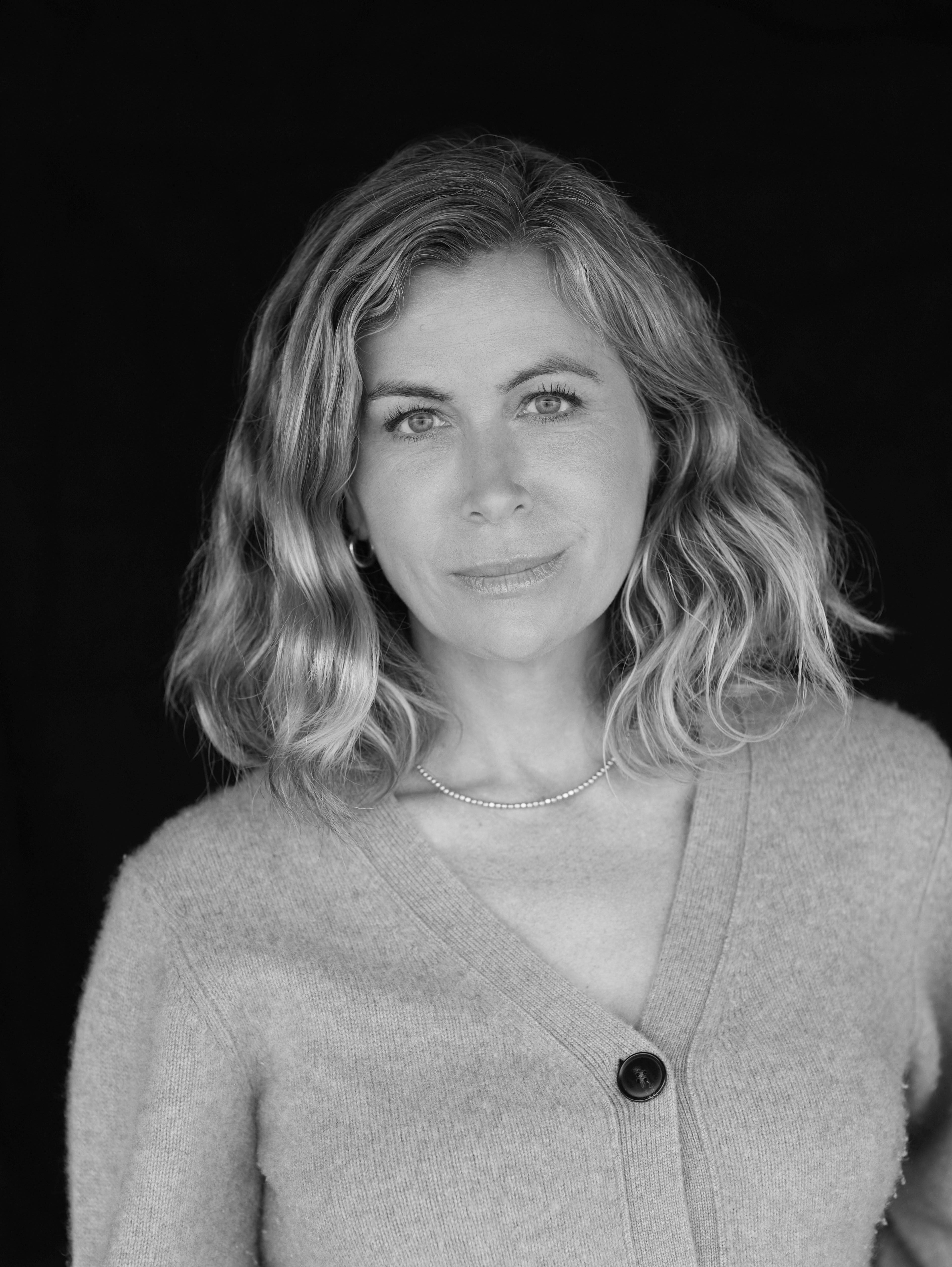
Film and TV fans know Sonya Walger primarily from her work on Lost, For All Mankind, and dozens of other films and television series. But the award-winning actress is also an extraordinarily talented writer with a degree in English Literature from Oxford. Her first book, Lion—published last year in the wake of the Los Angeles fires that destroyed her home—was called “a piercing autobiographical novel” by Publishers Weekly and was longlisted for the 2026 Carol Shields Prize for Fiction. Her latest, Wifehouse, is a brilliant work of fiction in which a middle-aged married mother of two, Annie, makes the complicated choice to put her own needs before those of her family.
But despite her recent success as an author, Walger isn’t planning to give up acting. In fact, in addition to promoting Wifehouse, she’s currently juggling the writing of her third novel with her portrayal of Freya in the highly anticipated live-action adaptation of God of War. And she says it’s precisely her training as an actor that enables her to write as well as she does.
“That habit of disappearing into other people and looking out at the world through their eyes, that’s all I’ve done,” she says. “I’ve been a glove puppet for years and years, so now to get to do it with all the parts is just an absolute joy. It’s so exciting to get to pretend to be a 67-year-old solicitor from the middle of England. Or in the case of Wifehouse, 14-year-old Vita. Or Jackson, desolate because Christmas didn’t happen. It’s an extraordinary thing to do. And it has affected me in that it just deepens you. I think empathy is a muscle, and the more you work it, the stronger it is. It’s made me a better listener, actually. The writer in me is listening for the great phrase or the interesting person, but I’m not just harvesting. I’m also like, ‘What is in there? What is making you feel that or wonder that or long for that?’”
I recently chatted with Walger about her evolving writing process, her advice for aspiring novelists, and what she hopes for her career going forward.
This content contains affiliate links. I am an affiliate of Bookshop.org and I will earn a commission if you click through and make a purchase.
SANDRA EBEJER: Like so many others, I know you primarily from your work as an actress. But you’re a voracious reader and lover of books, and you studied English Literature in college. When you were at the start of your career, was the goal to be an actress? Did you aspire to be a novelist? What were your plans?
SONYA WALGER: I don’t know. Maybe some people have plans. I didn’t have plans. I just fell into things. [Laughs] I have loved acting my whole life and I’ve loved reading my whole life, and they’ve gone in tandem. I went to a very academic boarding school, and they were all very keen for me to try for Oxford. I was not opposed to the idea, but I had also had a very keen drama teacher who was very keen that I try for drama school. But when I got into Oxford, that path swerved. There was no drama school that was going to compete with getting to study English at Christ Church. So, I went to do that but quickly found a group of people that did theater. You can’t study theater at Oxford. They don’t consider it an academic discipline. So if you’re going to do it, you do it in your own time. And so we did. There was a group of us, and we put on a play every term, basically, on the side, as well as doing our various degrees. I think all of us were studying English.
I got an agent while I was still there and started work as an actor because I sort of fell into it. But I’ve never stopped reading and I’ve never stopped journaling. I did stop writing at the beginning. It didn’t occur to me to write. I just was in that horribly passive state that one begins as an actor, where you’re just waiting—waiting for the phone to ring, waiting for life to happen, waiting for all these events to come. Thankfully, I was in my twenties when I started realizing this is no way to live. So, [I had] a steady diet of journaling and then I did short story courses at UCLA. I’ve written movie scripts. I just had stayed away from the novel. Because I read as much as I do, and because I revere it as I do, I was terrified of writing a bad book, so I just didn’t do it.
Anyway, in a bid to make things and be around people that make things, I did a podcast for a long time called Bookish, where I interviewed people about the books that had shaped them most. And maybe you have an experience of this—there came a point by about episode 30 where I was like, “I am so fed up of hearing people tell me about what they’re writing.” Not fed up—that is the wrong word—but moved to do this myself. Why am I not doing this? So I came to it very late, is the long answer to your question, but I think I had to go through all the things I’ve gone through in order to get where I am.

Wifehouse is one of the best novels I’ve read in a while. Where did the idea for it come from?
I’ve always been interested in marriage as a subject. I think it’s just made for the novel. I really do. I think they’re made for each other, this particular form and this particular topic. After Covid, I saw a couple of families splinter in ways that none of us had expected or foreseen. And when you see that happen close up, there’s a reckoning for you. I think we’ve all experienced friends breaking up, and you’re like, “Oh my God, should we? Are we? Is this us too? Is everyone doing this?” And the actor in me—I’ve had some great roles in my career, but I have spent a long time looking over being like, “But I want to play his part.” It’s usually the men’s that I have coveted.
So to suddenly try on for size a book in which I played all the parts, in which I took on the role of everyone around this incredibly fraught subject, which is sort of—I’m going to say maternal ambivalence, but I don’t think Annie is that ambivalent about being a mum. I think she loves being a mum. I think what she’s ambivalent about is the trappings that come with it. There’s a cultural hysteria around it that I was really keen to not participate in, but to try and look at why maybe people are so polarized and energized about the idea of a woman who chooses to leave her family. Because I feel it too. I’m not immune to that, but I really wanted to see it from all the points of view. That, to me, was the real challenge and the thing that made it interesting and made it a book I hadn’t read. I only want to write books that I want to read. So usually the bar I hold is, have I read this?
Creative Reverberations is a reader-supported publication. Each interview takes many hours of work. To read all posts and support ad-free, independent journalism, please become a paid subscriber.
Writing a novel is a daunting task. What is your process like? I saw something in your Instagram about the book Atomic Habits being helpful.
I think Atomic Habits is just a great rule for life. But I tend not to do anything slavishly. I like bits from everywhere. The one non-negotiable for me is a journal. And by a journal I mean 12. I don’t have a bag that doesn’t have a journal in it, and they are this scrapbook of everything from shopping lists to novel ideas to phone numbers. I spend my life leafing through all of them, trying to remember where I wrote that phone number down. But they’re all going all the time. I handwrite the first draft of everything, or I have to date. I’m deep into book three and I have four thick notebooks on that. Every book is different. I’m really learning that. Like having children, you’re the same person, and yet you’re not quite the same person as the one who wrote the last one, and your book is not the same thing.
[With] Wifehouse I had a few very clear images. One was that it should take place in the space of a year, and that it should begin and end with this Christmas lunch, this ritualized gathering of people, and what was the same and what was different between these two iterations. And then I had this other image that just haunted me, and I was like, “Well, then it goes in the book.” I had this image of a woman in a garden surrounded by her childhood furniture, and that there was a reckoning of who she was in the context of all this stuff. What was this stuff doing with her? What did it have to do with her? It was a bit like a dream image in that fragmented way. And so those became the tent poles for the book, and I was, with hindsight, so grateful for them, because book three, I’m much more at sea and much more like, “Where are my tent poles?” [Laughs]
One of the things I think you do really, really well is describe characters vividly. Each character in this book has their own distinct personality, their own way of being. Did you spend much time fleshing out the characters prior to writing the story itself?
Yes and no. Some of them I could hear right away, and others no. Sometimes it’s about getting the story down as much as possible, just getting it out. That’s what the notebooks are about in lots of ways. Just like, “All right, let’s imprint this. Let’s get it in.” And then in the many rewrites it’s, “Now let’s flesh out this person.” Annie was shadowy for me. I knew what she was doing; I just wasn’t deep inside her for a while. So I did many passes that were just burrowing inside Annie and sort of living with her. So, yes and no is the answer. Some of them I know distinctly, and some of them I have to keep [working at]. I feel like I want to do this gesture where you’ve got clay and you’re just working it a little harder to warm it up in your hands.
There are a couple of lines in the book that jumped out at me, both in reference to Annie. The first is “she is living in the cheap seats of her own life.” And the second is something she says in reference to her children: “I am being buried alive by the very things that keep them safe.” She is a character I was both elated and horrified to find I relate to in many ways, and she’s stuck with me after reading the book. How was it for you to create her and live with her during the course of writing?
I mean, you’re never done with these people. I think when you write a book, they’re all pieces of you. Again, it’s like a dream, writing a novel, in some ways. The experience of it is slightly dream-like, and hard and nightmarish too, but you emerge from it like, “All right, that was that experience.” But a dream is still in you. Those figments and fragments are still in your life. So I’m as much Hector as I am Vita as I am Candace as I am Annie. You just lean. It’s all about your center of gravity. You just lean more into that. I don’t think there’s a mother alive that hasn’t at some point been like, “Oh my God, can I just go to a hotel?” [Laughs] And if there is, I don’t believe her. Most of us have that and then pull back, and we keep on with the washing up or unloading the dishwasher. But just to lean a little more into that and inhabit that, and then add to it grief, bereavement, resentment, isolation, geographical isolation, and the presence of someone who listens—well, that’s a cocktail right there. That’s a thing to play with. And I’ve spent a long, long time pretending to be other people, so it doesn’t come unnaturally to me.
Is there anything that you struggle with as a writer?
[Long pause] Hmm. I mean, I want to say all of it, but no, not really. I’m really stubborn about things. I’m really only learning the kind of writer that I am. I find out who I am on the page. I think that’s the fascinating thing about it is you keep getting to peer behind the curtain, and there’s another person driving the ship, and you’re like, “Wow. I didn’t know you were in there. Al right, let’s work with you now.” I’m endlessly fascinated by the process of writing, because to have come to it in the middle of my life as someone more conscious and more cognizant and maybe more self-aware than I would have been had I been doing this in my twenties, it’s really interesting. It’s interesting to watch your hand move across the page and be like, “Look at that. There is a thing that did not exist minutes ago. There is a sentence and a string of words.”
And each book really is different. Lion was built out of tiny fragments that I then worked and worked and worked into this book. Wifehouse had its arc from beginning to end. My third book is born from a nugget of an idea and it’s period, so I’m working in a different time frame. This third book, for instance, I’ve filled four journals with handwritten notes. I’ve never read any of them. I just had to get it out of me, and now I’m writing the book. Whereas Wifehouse I very carefully transcribed what I’d written and then worked and worked and worked that. So are there things I struggle with? So far, it sounds like uniformity is what I struggle with. [Laughs]
You’ve been very open about the fact that you lost everything in the L.A. fires last year, just before Lion was published. I can’t fathom how one rebuilds after a loss like that, let alone promotes a book while going through that experience. How was that for you to juggle those worlds?
It was a lot. I’m not going to lie. I’d waited nearly two years for Lion to be published. NYRB had bought the book, and they release so few books a year, so I had to patiently wait my turn for it to be time. The drum roll for it had been long and every friend had basically read the book in manuscript form by that point. But it was very, very unexpected to have that as the backdrop. I had not anticipated promoting Lion against that sort of desolation. I will say the outpouring of love and support—that book launch at Diesel, the little bookstore here [in Santa Monica], was just packed with loving faces two weeks after the fire. There will never be a book launch like it. That was not just friends loyally coming out to support; that was a wall of love. And that felt extraordinary. Still does.
Yeah, it feels better to be talking about a book without my house in ashes behind me, but we still live with the repercussions of it. We’ve got stuff back, but the house is not rebuilt, and we’ve only been to see it once. It’s just painful to be there. We’re going to plow on and we’ll make it work.
You were the creator and host of the Bookish podcast, so you’ve spent quite a bit of time talking to others about their favorite books. I’m wondering if there are specific books or authors or even other works of art that have been influencing or inspiring you lately.
Yes. Whenever I’m working on a new book, I tend to be incredibly filtered about what I allow in. So Wifehouse, I just read books about adultery and women leaving for about two years straight, beginning with the obvious, Anna Karenina and Madame Bovary, but then going deep in—Tom Stoppard’s play The Real Thing, which is one of my all-time favorite plays, and poetry and essays written by female artists, and studies on Louise Bourgeois. Everything is in the pot, as far as I’m concerned, but I’m quite disciplined about not really letting in what doesn’t belong. Right now what I’m doing is set between the wars in England, so there’s been a lot of Virginia Woolf and Muriel Spark, Sylvia Townsend Warner, Barbara Comyns. They’re very English, between the war writers, women, almost all of them, and that’s been juicy and great. And then I read Flesh, which I loved, and thought was an astonishing book, and was actually helpful. I’m writing something that’s completely different, but so often writers extract the DNA of something and then weave it into the helix of their own, and there was something in Flesh that was really, really helpful.
Will there be another season of the podcast?
I can’t do it all. The podcast, as you know, is so demanding and the research is so intense, and you want to do it right, and you want to do every guest justice. And I don’t have a producer, so it was all me. I love the interaction, the human everything. The procuring the dates, the assistants, the agents, that—I don’t need to tell you—I was just like, “I’m done. I can’t.” So I did 36 episodes. Maybe I’d come back to it. What I love about the podcast is that it’s evergreen. There’s no date on it. I would love to do it again, but I can’t imagine how to do it while I’m writing novels.
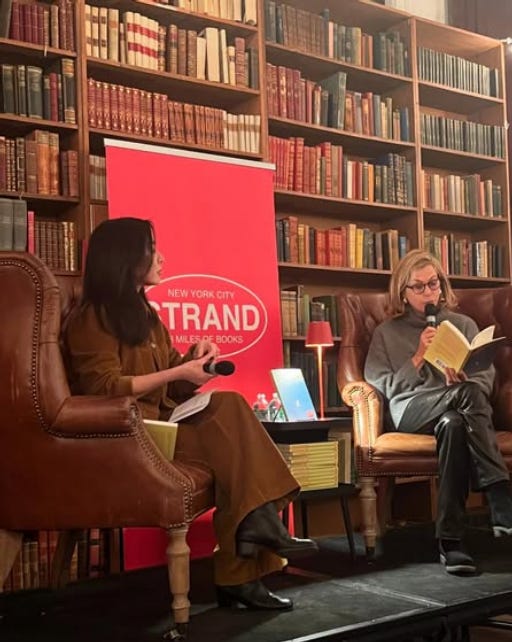
The first half of your career was primarily as an actor, and you did the podcast for three seasons. Now you’re writing novels. When you look ahead, do you have any specific idea of what you might want your career to be? Are you looking to just write? Are you more interested in acting? Do you have a preference?
No. I just got an acting job. I’m working again. That was very unexpected. I’ve been so happy writing books for the last four years and I really hadn’t expected to go back to acting. I hadn’t officially retired. I still have my agents and my manager and all my people, but mostly because they’re my friends, and I wasn’t going to fire anybody, and it doesn’t cost anything to keep them on. But I think I’m probably the most surprised to find myself back on set. I think my husband was like, “Of course you were going to act again.” And so were my agents. They were like, “Yeah, we were going to do this again.”
I feel a little taken aback to find myself on a soundstage again, but I feel very differently about it now. Like, I just get to keep making things. While the cameras are rolling, I’m going to be doing that, and then I’m going to be in my trailer and I’m going to write. So to have this thing in tandem and to feel very precious about my books, like I do about my children, where I’m like, “Yeah, great. I do this thing, but I’m also there for bedtime.” I feel like that. I feel like, “Great. I do this thing, and I have to finish book three.” So, I’m hoping for a long career, I guess, of both. But if you’d asked me three weeks ago, I’d have told you that just novels were great and that that’s what I was doing. So this is a new thing I’m still trying to incorporate.
That’s great that you have both. What advice would you have for aspiring novelists?
It would be the same advice that I give to actors, which is you have to uncouple from outcome. You just keep doing it. To be an artist is such an extraordinary life to get to live, and to witness the miracle of, that thing was inside me and invisible and now it exists—there’s no one that can take that away from you, whether it’s published or not, whether it lives on your desktop or in your journal. There has to be a part of you that is doing it for the sheer love of the miracle of making things. And bills need to be paid, God knows. I know that. But I really do believe that a dogged devotion to yourself, rather than to the need to have it in the world, necessarily, reaps results and makes for great art.
To learn more about Sonya Walger, visit her website.
To purchase Wifehouse, click here.
This interview has been edited for clarity and length.
You might also enjoy…


Great interview, she’s a remarkable woman.