


We are a nation so obsessed with true crime that it’s difficult to remember a time when the top podcasts, documentaries, and series weren’t focused on dissecting real-life murders and grisly assaults. Of the many filmmakers working in the space today, Joe Berlinger has the most unique vantage point. Not only is he involved with two of this summer’s top true crime series—The Idaho Murders and Conversations with a Killer: The Charles Manson Tapes—his earliest films, 1992’s Brother’s Keeper and 1996’s Paradise Lost: The Child Murders at Robin Hood Hills, helped to shape the genre as we know it. Still, he’d be happy never to hear the phrase “true crime” again.
“There is a lot of irresponsible true crime that doesn’t care about the victim or moving the needle forward from a social justice standpoint,” Berlinger says. “And it’s irreverent in tone, making light of somebody’s worst day. That’s why I don’t like the phrase ‘true crime.’ Brother’s Keeper, Paradise Lost, and Errol Morris’s Thin Blue Line are the foundational films of true crime, so I do think I’m a pioneer in the space, but I don’t like the ‘true crime’ part. There’s not a project I take on where I don’t say to myself, ‘Is there some reason to tell this story other than just wallowing in the misery of others?’ If I can’t say yes, then I won’t do the project.”
Arguably his most impactful film, Paradise Lost, co-directed with Bruce Sinofsky, premiered on HBO in 1996. It follows the trials of Arkansas teens Damien Echols, Jason Baldwin, and Jessie Misskelley, who are accused of killing three eight-year-old boys. Though it’s apparent there is little evidence tying the teens to the murders, they’re found guilty, with Echols being sentenced to death and Baldwin and Misskelley given life sentences. The film and its two subsequent sequels shed light on the case, garnering national attention and launching a movement to “free the West Memphis Three.” As a result, the three men were released from prison in 2011 after serving 18 years.
In honor of Paradise Lost’s 30th anniversary, I spoke with Berlinger about the making of the film, building trust with his film subjects, and his unusual career path.
Creative Reverberations is a reader-supported publication. Each interview takes many hours of work. To read all posts and support ad-free, independent journalism, please become a paid subscriber.
SANDRA EBEJER: How did you first hear about the Arkansas murders and what made you decide the story was worth pursuing?
JOE BERLINGER: The most fascinating part of this story is that I and Bruce Sinofsky, who passed away in 2015, made three films over two decades that are considered classics in the wrongful conviction space, but started off as a film about murderous teens. We went down to Arkansas thinking, “How could three teenagers be so disaffected from life that they would sacrifice three eight-year-olds to the devil?” That’s the film HBO wanted.
This whole thing started [because] Sheila Nevins [then President of HBO Documentary Films] was a fan of our first film, Brother’s Keeper, which we made on a dozen credit cards and second mortgages. We gambled everything, it got invited to Sundance and won the audience award, and then all of a sudden at the age of 28 I’m a filmmaker and get the call from HBO. Back in the day, there were only two games in town: PBS for the talking head, historical doc, and if you wanted to do verité, there was HBO. No such thing as doc series; no such thing as streaming. So when you got that call from Sheila Nevins at HBO, man, you had arrived.
She sent over an article—it wasn’t even a big story in the New York Times—that three teenagers had been accused of devil worshiping murders. The murders happened in May of ’93 and she sent me the article a week after they were arrested and arraigned, which was June of ’93. We went down to Arkansas thinking we’re making a film about these horrible teenagers and for months, we only spent time with the police, the prosecution, and the families of the victims who were convinced these guys were guilty. Then in November of ’93, we negotiated access to the three teenagers who were accused of these crimes, who were in county lockup without the possibility of bail awaiting trial.
I remember doing the first interviews with each of them. Damien was hard to read. He would later say he never imagined it would result in a conviction, so he liked playing with the press. You see that in the film. He comes across as a little arrogant. Jessie Misskelley has a very low IQ and had a separate trial. But in my interview with Jason Baldwin, I was overcome with this feeling that something is not right. He had a scrawny wrist, and while I’m interviewing him, I’m imagining him wielding a 10-inch serrated hunting knife and doing terrible injuries on these children. By all accounts, [he was a] loving kid—took care of his little brother, cared about school—and I looked at his wrist and couldn’t imagine this guy did this. It’s not like a light bulb went off and Bruce and I said, “Oh my God, they’re innocent.” We just said, “Something is not right here. One plus one is not equaling two.”
I remember with much trepidation calling Sheila Nevins. What is her reaction going to be when I tell her it’s not a kids killing kids film? Is she going to cancel the project? I call her up and say, “I don’t think this is as straightforward as it seems. The evidence we’ve been presented feels circumstantial and I feel like there’s a good chance they’re innocent.” To her credit, she said, “That’s even more interesting. Stick with it.” So, ironically, it started as a kids killing kids film and became a classic of the wrongful conviction genre.
When you were making the film, did you have any idea that it would have such an impact?
None whatsoever. There’s a few things that worked in our favor that one couldn’t have predicted. One is we took a long time to edit, in part because we hadn’t made the shift to digital editing. We shot all the behind-the-scenes on 16mm, and we shot the trial sequences on video. Because we had way more film than video, we did a reverse situation—instead of transferring our 16mm to video and doing the edit on an Avid, we took all of our trial footage, transferred it to 16mm, and edited the whole film on a Steenbeck.
We wrapped the project in March of ’94, but it took almost two years to cut the film, and it premiered in January of ’96 at Sundance. The internet was just coming into being, and in ’96, the internet was being used by people of like-minded interests finding each other in a way that hadn’t happened before. Had the film come out a year before, it would not have had this phenomenon. But after its HBO premiere in June of ’96, people were shocked. They felt, “I was an outcast, too. I dressed in black. I listened to Metallica music. I could have been that person.” It struck a chord with people, and that’s what helped the case because tens of thousands of people banded together.
What impact did the film have on you personally?
It was my introduction to the idea that wrongful convictions not only can happen, but they happen a lot. Going into Paradise Lost, it was more about aesthetics than a desire for socially conscious, criminal justice reform filmmaking, which has been a hallmark of my work ever since. We sat through this trial and saw no forensic evidence linking them to the crime. I didn’t know about the concept of false confessions until this case. Why would somebody confess to a crime they didn’t commit? Well, there’s lots of reasons and it happens all the time.
I remember like it was yesterday—it’s the final scene of Paradise Lost—Jason is sentenced to life without parole and Damien is sentenced to death. The guards are chaining them up and leading them off, and Bruce and I and our cameraman, Bob Richman, all looked at each other. We were emotionally gut punched. We couldn’t believe we just witnessed a modern-day witch hunt where Metallica lyrics are literally being introduced into evidence as a sign that they’re killers. Stephen King books were introduced as evidence. Damien liked to read Anton LaVey. Yes, he’s a Satanist, but you need more at a murder trial if you’re going to put someone to death than what they’re reading. So when those guys were rounded up, we looked at each other and realized, “Wow. We’re sitting on something that could move the needle.” It’s that moment that I [realized] film can be used to shine a light on wrongful convictions. We have the power to make change. When the film came out, we were expecting the prison doors to bust wide open. But in Arkansas, people thought we were just a bunch of Hollywood hucksters. It was dismissed as B.S. in Arkansas.
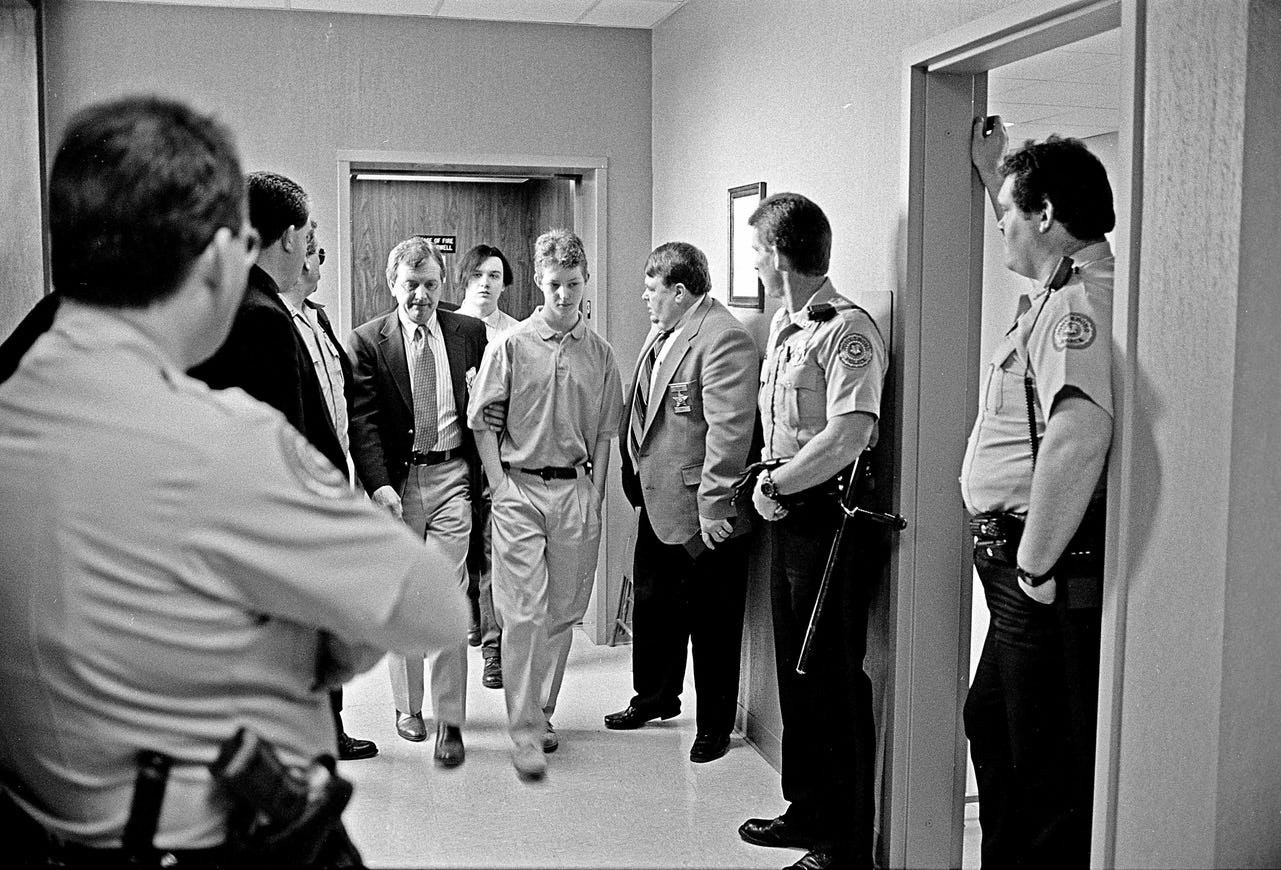
The film was nominated for Emmys, DGA awards. Of course, that’s fulfilling. But by the time we were getting awards, Damien had been on death row for three years and there was a part of us that felt like phonies. We’re holding our statues, giving speeches at award shows, but the real person it’s about is on death row, being terribly mistreated, and the movie hadn’t moved the needle yet. So we said, “We’re going to keep making films.” I think the first film is a beautiful example of cinema verité. The second film is an advocacy film in search of a story. The second film is probably the weaker of the three films.
But the third film, Peter Jackson funded a bunch of DNA testing. They found DNA belonging to a stepfather that might be responsible and the judge completely dismissed it. This is legal in some states—the presiding judge at the original trial can preside over the appeals process. How is an appeals judge going to find reversible error by the original judge if it’s the same person? But Judge Burnett somehow played both roles and dismissed all of the Peter Jackson evidence. We had already been making Paradise Lost 3 around 2002. It really amped up after the evidence was dismissed, and the third film came out magically right around the time that they were [released].
When working on a project where the content is so disturbing, how do you take care of your own mental health?
Compartmentalization is very important. I learned the lesson the hard way when we were editing Paradise Lost. We open with that horrific crime scene footage—the bodies being pulled from that creek, naked, hogtied, injured—and that was controversial at the time. People were upset that we opened the film with that, but I thought it was important that you understand how shocking the crime was to that community, to understand how an entire community could be brainwashed by the prosecution and the police with this crazy tale of satanic cults. By starting the film with grisly footage, I wanted people to understand just how a community was so fearful of letting their kids out the door that they had to have an answer, that the police were under pressure to solve a crime and they came up with this bizarre story that people believed.
But while we were editing it for the couple of minutes of footage that appears in the film, we’re going through hours of footage, looking at stuff no one should look at, especially if you’re a new father. I had a nine-month-old daughter. And because we cut on Steenbeck, everything takes longer and these images are imprinted on your brain.
Our office was in Manhattan. I lived an hour away. I’m driving home thinking about this stuff. I walk into my house, go up to the nursery where my daughter is sleeping. I’m looking at my beautiful nine-month-old baby girl, and I’m flashing on these horrible images, like I had stared into the abyss of evil and couldn’t take it back. I started to resent the project and what it was doing to me because now it’s ruining this irreplaceable precious moment as a young father.
So I developed a system. I created my own personal talisman, which was a rock from my favorite beach. Whenever I’d come home, I’d take my beach rock and toss it into an ashtray on a table at the entryway, and that was my way of saying, “I’m leaving the work behind me.” And as I left the next day, I’d take that rock and put it in my pocket. “Okay, I’m going to work.” So the rock became my symbol of, “That’s work. And when I get home, I’m not thinking about it.” And it helped. But there’s also a positive value, in the sense that when you see the misery some people are forced to go through in life—both a parent losing a child in the most horrific way and somebody being wrongfully convicted and on death row for 18 years—it makes your problems seem relatively small. So, I try to channel that gratitude in my thinking.
You’ve said you’re not a fan of the “true crime” genre. Why is that?
True crime has become somewhat formulaic, but I have mixed feelings about that because I think some of the formula I helped create. I mean, Bundy Tapes was a breakthrough show that was number one on Netflix. And ever since that show came out, how we light interviews, the spinning tape—a lot of that stuff has been emulated. So, on one hand, it’s become formulaic. On the other hand, I feel like I’ve helped set the formula.
The irony is I went into focusing on crime because I discovered wrongful convictions. There’s been an epidemic of wrongful convictions in this country. We estimate there’s probably two million in prison today, and wrongful conviction experts think up to 5% are wrongfully convicted. That’s 100,000 people that are potentially wrongfully convicted. That’s what I got into it for. My work, and the behind-the-scenes heroes doing the legal work and advocacy, have helped catalyze seven people getting out of prison, three from death row. That’s pretty cool. That’s the world I like to live in.
I’ve been on a serial killer jag because Stephen Michaud, who wrote Ted Bundy: Conversations with a Killer, reached out to me in 2018 and said, “I just found the audio cassettes I used in 1989 to record Ted Bundy. Do you think there’s an interesting film there?” I said, “I don’t know. That story’s been told so many times. Let me listen to the tapes.” The tapes were revealing. Even though he’s an unreliable narrator, you’re still learning stuff about him in a way I had never heard before. So I pitched to Netflix Conversations with a Killer: The Ted Bundy Tapes and they bought it. It was the top nonfiction title that year, so of course Netflix wanted more, and we’ve done five seasons.
Every time I do one of these, I say to myself, “What needle can I move?” With Ted Bundy, I also did a scripted movie with Zac Efron playing Bundy. Before I did the projects, I was sitting around the Thanksgiving table with my daughters. I said, “I’m thinking about doing Ted Bundy as a show. What do you guys think?” And they didn’t know who Ted Bundy was. I thought, what is the lesson of Ted Bundy? Just because you’re charming and good looking doesn’t mean you should trust somebody. To put something out that reminds people that you have to be careful who you trust felt like a worthy goal.
I don’t think it’s romanticizing the killer; it’s treating the killer for who they really are. Most people who do evil in this world are the people you least expect and most often trust. We want to think that serial killers emerge from the shadows looking evil. That gives us the false sense that we can protect ourselves from being a victim because they’re easily identifiable. But the truth is, you can’t believe it when you learn that person’s a serial killer because they have a wife or friends. They’re the guy at the office who’s the life of the party. That’s how these people operate. So I think there is a lot of irresponsible true crime, and I always [ask myself], is there a reason to tell this story beyond just the story? That’s the filter I put it through.

Some of my favorite films of yours—Paradise Lost, The Idaho Murders, Whitey—are about community. In each one, you’re embedding yourself into a community and asking its members to talk to you. And you’re an outsider; you’re not from Arkansas or Idaho or South Boston. How do you go about gaining trust and getting people to open up?
I believe in karma. I think what you put out in the world you get back. A big part of my philosophy is treat people, even a guy on death row who is a murderer, with the respect they deserve as human beings. If I’m trying to talk somebody into being in a show, I always say, “These are reasons you should do it and these are reasons you shouldn’t. You will be recognized on the street. Do you want that in your life?” And some people come back to me and say, “Thank you for telling me that. I decline to participate,” and I feel good about it because I want people to know what they’re getting themselves into.
The other technique, which is harder on today’s budgets, is we would spend time with people not filming. In Brother’s Keeper, we got access to the Ward brothers. They had no concept what it meant to make a film. These are people who lived like people lived in the 19th century. We decided not to film for the first three or four weeks of going up there. We did chores with them. Sometimes we’d sit on the lawn and just pass the time. Not filming and getting to know people is as important as [filming]. You get to a location, and you just want to start shooting stuff, and sometimes it’s better to have some patience. Intentionality is everything. What is your intention? Why are you making this film? Are you making this film to be famous, or to move the needle? Why are you telling this person something? Are you being honest with them? Intentionality is a big thing.
When did you first get into this line of work? Did you study filmmaking?
Honestly, it’s a bizarre arc. When I was a teenager, I saw Holocaust liberation footage for the first time—Buchenwald being liberated, the corpses being bulldozed, the emaciated survivors. I couldn’t get it out of my head. I was living in Westchester County, New York. We were Jewish, technically speaking, but very secular. We were German but had no German traditions because we’d been here for multiple generations. And we didn’t lose anyone in the Holocaust.
So I was thinking to myself after seeing that footage, “I’m Jewish, but not really. I’m German, but not really. But had I been born there, I would have been murdered.” I couldn’t get that out of my head. I didn’t say, “I want to be a filmmaker.” I thought, “I want to speak and understand German.” Because you can’t just say, “Germans are evil. That’s why the Holocaust happened.” That’s an overly simplistic explanation. So when I went to college, I became a German major. I became fluent in the language and when I was graduating from Colgate University in 1983, I was interviewing with any company that could pay me. My goal was, how can somebody pay me to work in German-speaking Europe, and I can use my language skills? Thanks to the help of a friend whose father was a bigwig at this ad agency Ogilvy & Mather, I bluffed my way into being an account coordinator at Ogilvy in Frankfurt. My job was to make sure everyone was happy when American clients came over to shoot their German version of TV commercials, and that’s what exposed me to TV and film. The first time I was on a film set was an American Express commercial being shot in Germany, and that’s when the light bulb went off. It’s like, “The hell with this German thing! I want to get into film.” But not as a documentarian. I was living in Frankfurt and Jim Jarmusch’s Stranger Than Paradise came out there. That movie was transformative to me.
They transferred me back to Ogilvy in New York, and I’m trying to figure out how to get into the film business. A friend of mine introduced me to [filmmakers Albert and David] Maysles. They were hired to shoot documentary-style commercials, and I was looking to get into film, so I started working as their executive producer for commercials. They wanted some young guy to take their reel from ad agency to ad agency and get them commercial work, and that was my job. I decided I wanted to make a short film about New York City cab drivers. That was in 1989 and it became a film festival darling. And then Bruce and I decided to make Brother’s Keeper together.
The bottom line is, it’s very random how I became a documentarian. Because if I had hit it off with Ridley Scott and Ridley Scott wanted some guy to get him more commercial work and invited me to work for him, I could have just as easily been a feature filmmaker at the start of my career. But I believe things happen for a reason. I love the fact that I’ve had this career for the last 30 years. Having a camera has been a ticket to enter people’s lives, whether it’s the worst moment of their life or the best moment of their life. It’s a constant education of being invited into places and learning about life in such a profound way. I can’t think of anything else I would have liked to have done at this point.
To learn more about Joe Berlinger, find him on Instagram.
This interview has been edited for clarity and length.
You might also enjoy…

